Clothing and facial patterns deliberately challenge a computer vision model. False faces on fabric, adversarial shirt prints, all-over garment textures and graphic makeup target different steps in machine perception.
4 illustrated examples. Follow each disguise to its full entry, image and sources.
Tricking AI
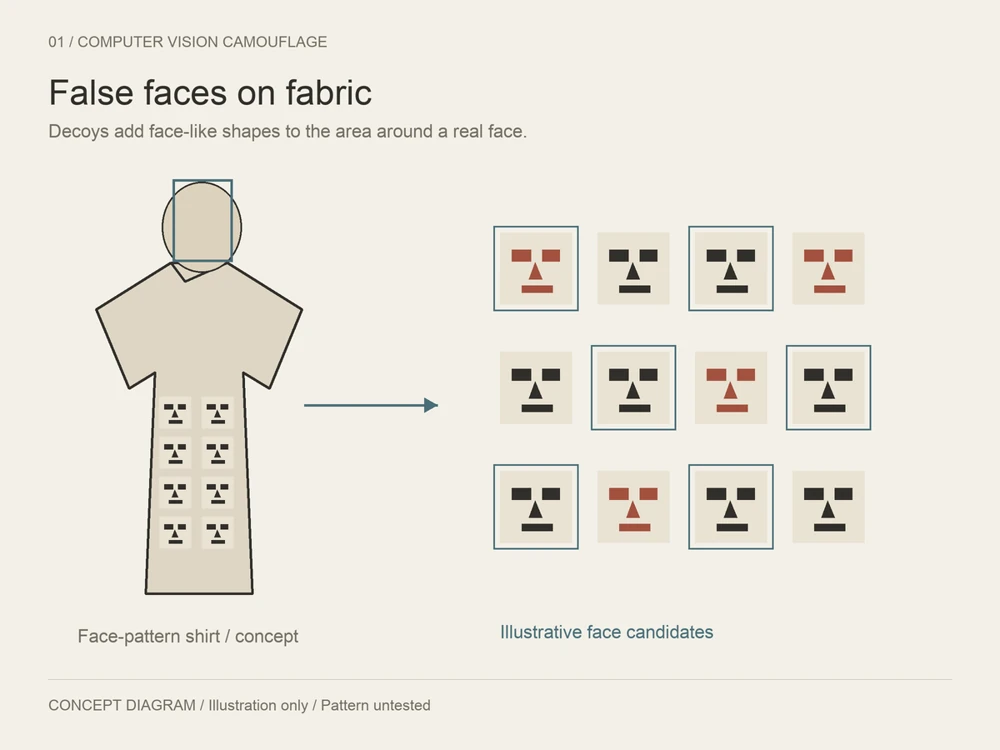
Original concept illustration of false faces on clothing. The documented HyperFace prototype used a scarf; this shirt is an explanatory adaptation. Image: Through Mirror — original explanatory diagram · Source · CC0 1.0. Original concept illustration; pattern untested; viewing previews may be resized.
01 / Face-detection decoys
HyperFace — False Faces on Fabric
Adam Harvey, in collaboration with Hyphen-Labs · NeuroSpeculative AfroFeminism; computer vision camouflage
Repeated face-like patterns on fabric try to redirect a face detector towards decoys around the wearer.
HyperFace was launched as a textile prototype for Hyphen-Labs’ NeuroSpeculative AfroFeminism project at Sundance in 2017. A scarf carried abstract false faces, exploring privacy through fashion and speculative design. The same idea helps explain why a face-pattern shirt might be designed for a machine’s visual expectations.
The original pattern targeted OpenCV’s Viola–Jones Haar-cascade face detector. Face-like contrast on the fabric could trigger false positives. The proposed decoy effect exploits a system that prioritises a candidate face; a system that keeps multiple detections may still find the real face. Adding face candidates does not establish that identity matching has been defeated.
LOOK FOR THE DISGUISE
Find the repeated eye-and-mouth arrangements on the illustrated shirt and enlarged fabric. The blue boxes suggest candidate regions a detector might consider; they are drawn annotations, not algorithm output.
Harvey states that the displayed HyperFace patterns were tested only for a particular older detector and that their useful camouflage period has passed. This illustration is not the original pattern and has not been tested.
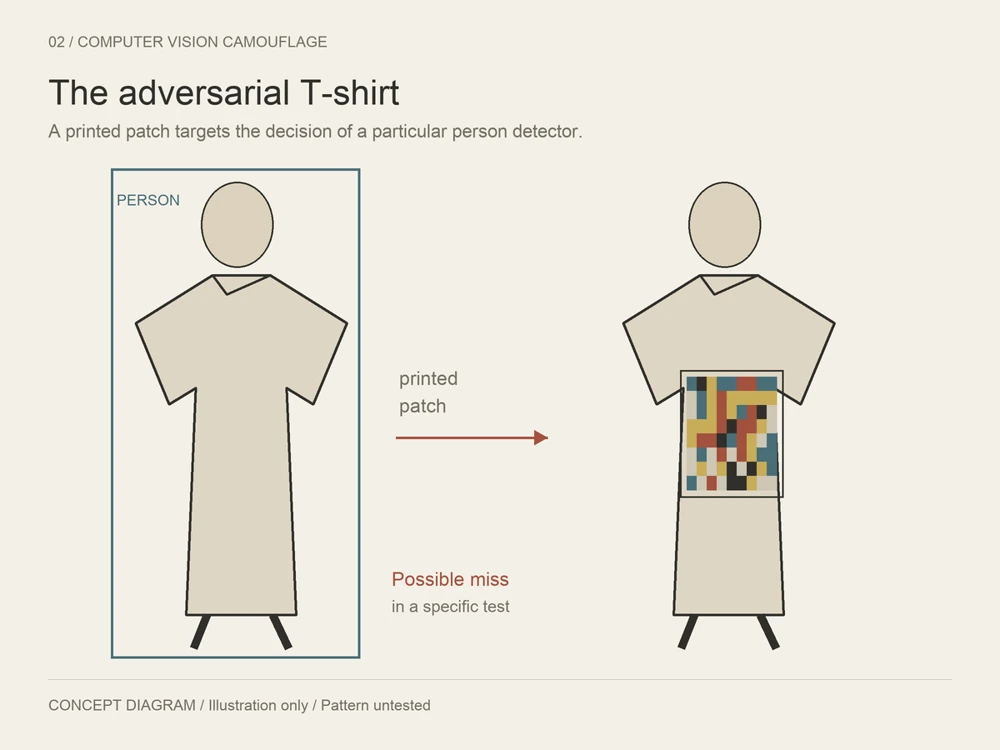
Original explanatory diagram of a possible person-detector miss. The coloured patch is illustrative and is not the researchers’ tested print. Image: Through Mirror — original explanatory diagram · Source · CC0 1.0. Original concept illustration; pattern untested; viewing previews may be resized.
02 / Adversarial pattern for person detection
Adversarial T-shirt — A Print That Challenges Person Detection
Kaidi Xu and co-authors · Physical-world computer vision research
A deliberately designed shirt print can make a tested person detector miss a wearer who remains visible to people.
The research paper Adversarial T-shirt! studied printed clothing that challenges person detectors. Unlike a flat image on a board, a shirt bends and wrinkles as its wearer moves. The researchers included fabric deformation when developing the pattern.
An adversarial pattern is selected to change a model’s decision, rather than to match the background. Xu and colleagues reported a 57% physical-world attack success rate against YOLOv2 in their experiments. That figure describes their evaluation, not a general chance of avoiding cameras. The target was locating a person in an image, rather than recognising the wearer’s face.
LOOK FOR THE DISGUISE
Compare the two illustrated figures. Both remain plainly visible. The right-hand shirt carries a coloured patch, and its absent person box represents a possible detector miss, not an actual test result.
Performance is tied to the tested models and conditions. Fabric folds, viewpoint and the captured image affect the pattern. A missed person detection does not demonstrate failure of a separate facial recognition system.
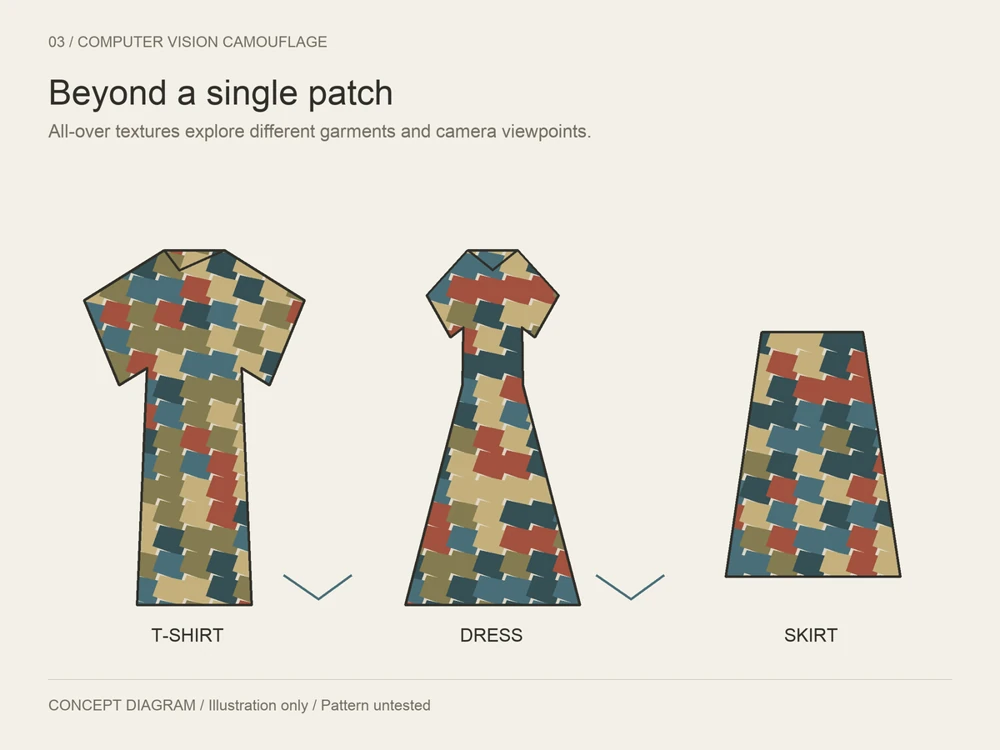
Original concept illustration of all-over patterned garments. These geometric textures are not reproductions of AdvTexture or validated camouflage. Image: Through Mirror — original explanatory diagram · Source · CC0 1.0. Original concept illustration; pattern untested; viewing previews may be resized.
03 / All-over adversarial texture
Adversarial Textiles — Shirts, Skirts and Dresses
Zhanhao Hu and co-authors · Printed fabric and physical garment experiments
A pattern spread across a garment explores how clothing can confuse a person detector from different angles.
The 2022 AdvTexture study extended physical camouflage beyond a single front-facing patch. Hu and colleagues printed patterned cloth and made T-shirts, skirts and dresses to test against person detectors.
Turning changes which parts of a garment the camera sees. A patch may leave the view or become incomplete. AdvTexture explores repeated structures across the cloth so different visible portions can affect the detector. The authors demonstrated failures in their physical experiments; the claim concerns particular person detectors, not every AI model or facial recognition system.
LOOK FOR THE DISGUISE
Compare the patch on the previous shirt with the all-over patterns here. Imagine the wearer turning: the visible fabric changes even though the garment is still patterned.
Covering more fabric addresses a viewpoint problem; it does not prove universal protection. Results need to be assessed against the actual model, garment and camera conditions. This diagram illustrates coverage only.
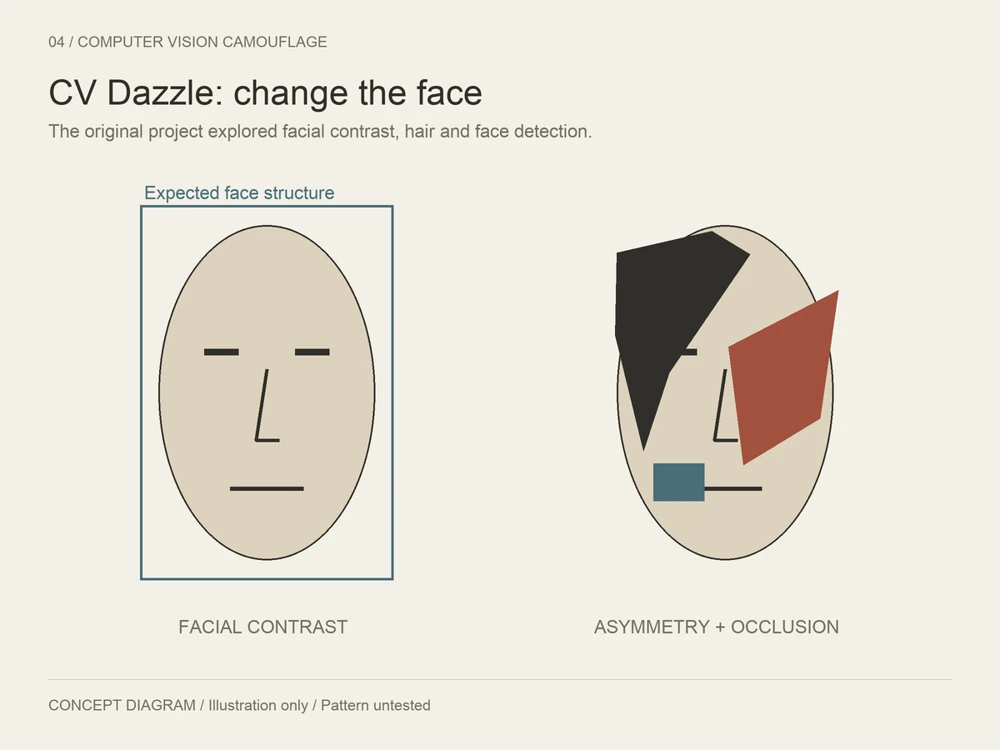
Original diagram of a facial-camouflage strategy, rather than a reproduction of a CV Dazzle look or a detection experiment. Image: Through Mirror — original explanatory diagram · Source · CC0 1.0. Original concept illustration; pattern untested; viewing previews may be resized.
04 / Facial contrast and face-detection camouflage
CV Dazzle — Facial Patterns, Hair and Machine Vision
Adam Harvey; collaborating hair and makeup artists · NYU thesis project; later fashion experiments
Graphic makeup and hair explore how a visible face can fall outside a particular detector’s expectations.
Adam Harvey developed CV Dazzle in 2010, borrowing its name from ship dazzle camouflage. The original looks combined makeup and hairstyling to challenge the Viola–Jones face detector. Later work explored designs for newer systems.
The original detector relied on arrangements of light and dark facial regions. Changing those arrangements could prevent a face detection in specific tests. A recognition pipeline that needs that detection may then lack a face to match, but detection and identity matching are different tasks. Unlike HyperFace’s surrounding decoys, CV Dazzle changes the facial area itself.
LOOK FOR THE DISGUISE
Compare the face diagrams. Notice how the asymmetrical hair and graphic areas change the visible contrast. The markings explain the strategy; they are not a tested makeup design.
Harvey advises against using the original looks against newer systems. A look depends on the wearer, algorithm and environment. These illustrations do not demonstrate effectiveness against a present-day facial recognition model.
Computer vision camouflage uses clothing, textures or facial patterns to challenge a particular model’s interpretation of an image. Person detection, face detection and identity recognition are separate tasks.
Do these patterns work against every AI camera?
Results depend on the tested model, viewpoint, lighting, distance, movement and fabric deformation. An explanatory diagram is not a tested camouflage pattern, and success against one model does not establish success against another.