LIGHT / WAVEFRONTS / APPARENT REALITY

Optical holography.

A flat recording can recreate light from a three-dimensional scene. Explore interference, wavefront reconstruction and parallax through transmission, reflection and rainbow holograms.

3 examples, with diagrams, photographs and source demonstrations.

Optical holography

FROM A RECORDING TO A WAVEFRONT

How can a flat plate contain depth?

A wavefront describes the shape of a travelling light wave. Holography records enough information to reconstruct the light arriving from a scene, so different viewing positions can reveal different perspectives. Dennis Gabor developed the method in 1948 while pursuing better electron microscopy; lasers enabled a major revival in the 1960s, and he received the 1971 Nobel Prize in Physics.

  1. Record the interference

    Coherent light from an object overlaps a reference wave. Their bright and dark interference fringes encode amplitude and relative phase: the strength and timing of the light waves.

  2. Keep the pattern

    A sensitive material stores this microscopic structure. The developed hologram holds the encoded wavefront; it need not look like a recognisable photograph of the object.

  3. Reconstruct the light

    Suitable illumination is diffracted by the pattern, recreating a wavefront. Your eyes receive different views as you move within the viewing zone, giving a sense of depth.

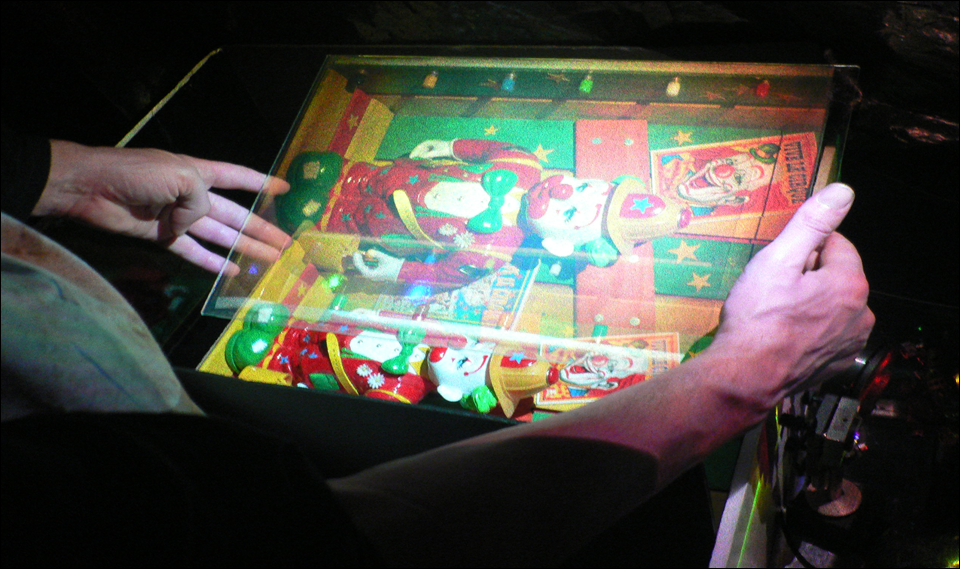
A photograph or screen view captures one perspective of a physical hologram. To experience its parallax, you move in front of the illuminated plate. Some holograms need laser light for viewing; reflection and rainbow methods can work with white light.

A colour hologram by Yves Gentet.
A photographed colour hologram by Yves Gentet. A screen shows one view of the physical hologram. Image: Holopro · Source · CC BY-SA 4.0. Photograph of a colour hologram by Yves Gentet; a separate example from the named artworks.; viewing previews may be resized.
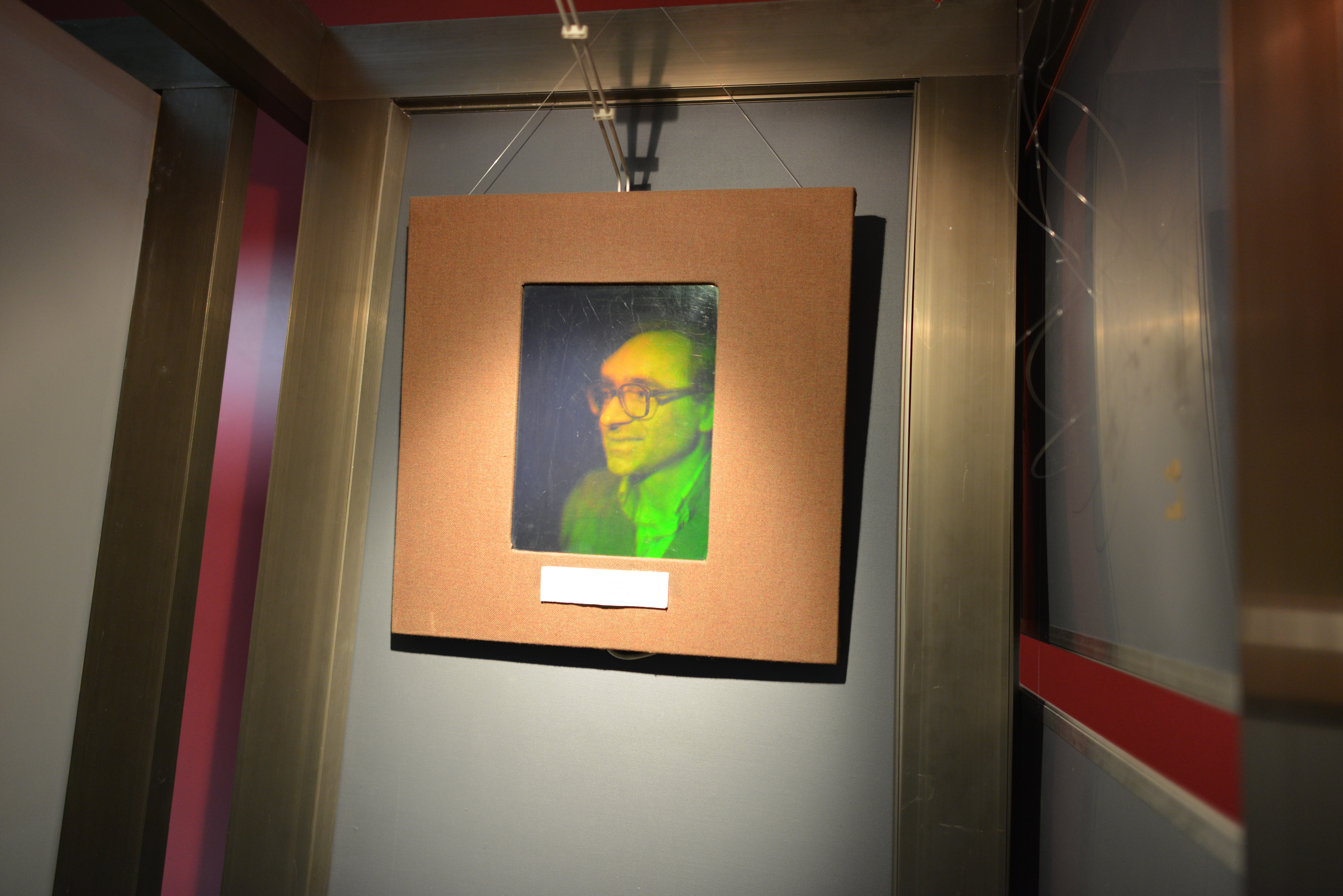
Ventseslav Saynov’s holographic self-portrait at a museum in Sofia.
Ventseslav Saynov’s holographic self-portrait (1995), exhibited at the National Polytechnic Museum, Sofia. These photographs illustrate physical holograms; they do not reproduce the artworks below. Image: Georgy Palpurin ShareBulgaria team · Source · CC BY-SA 4.0. Photograph of Ventseslav Saynov’s holographic self-portrait (1995), exhibited in Sofia.; viewing previews may be resized.
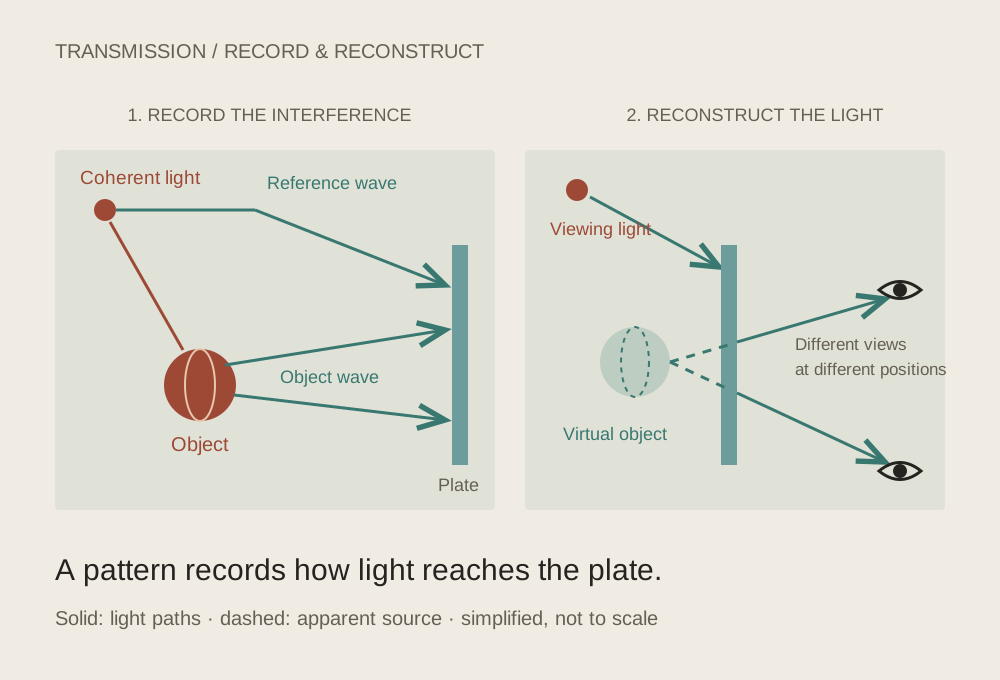
Original two-panel diagram showing an object wave and reference wave meeting at a holographic plate, then a developed transmission hologram reconstructing a virtual object for a viewer on its opposite side.
Original explanatory diagram; follow the source link to see the real example. Image: Through Mirror · original explanatory diagram · Source · CC0 1.0. Original explanatory diagram (2026); viewing previews may be resized.
See Optical Interactions in the artist’s archive ↗
01 / 1984 · laser transmission hologram

Transmission holography — Optical Interactions

A recorded still life becomes a window onto depth

A flat glass plate reconstructs light from a still life. Move sideways and the objects reveal a different view, as though you were looking through a window.

Gary Fisher made Optical Interactions in 1984 using a high-resolution holographic glass plate. Its still life incorporates a cylindrical lens, a faceted glass sphere and several mirrors. Fisher documents it as a laser transmission hologram, reconstructed with an expanded laser beam and exhibited in Images in Time and Space in Los Angeles in 1988.

During recording, coherent light scattered by the object meets a reference beam at the plate. Their interference pattern encodes the object wave’s amplitude and its phase relative to the reference. During viewing, suitably directed laser light passes through the developed hologram and is diffracted into a reconstructed wavefront. Different viewing positions receive different perspectives of the recorded scene.

EXPLORE THE HOLOGRAM

Open Fisher’s photograph of Optical Interactions and identify the sphere, lenses and mirrors. A photograph preserves one viewpoint. At the physical hologram, move sideways within its viewing zone: nearby and distant details shift relative to one another. This change is called parallax.

This is a laser-viewable transmission example. Other transmission methods, including rainbow holography, allow white-light viewing. The diagram shows the general recording and viewing principle, not Fisher’s apparatus or composition.

Gary Fisher · Optical Interactions

Open the full entry & images →
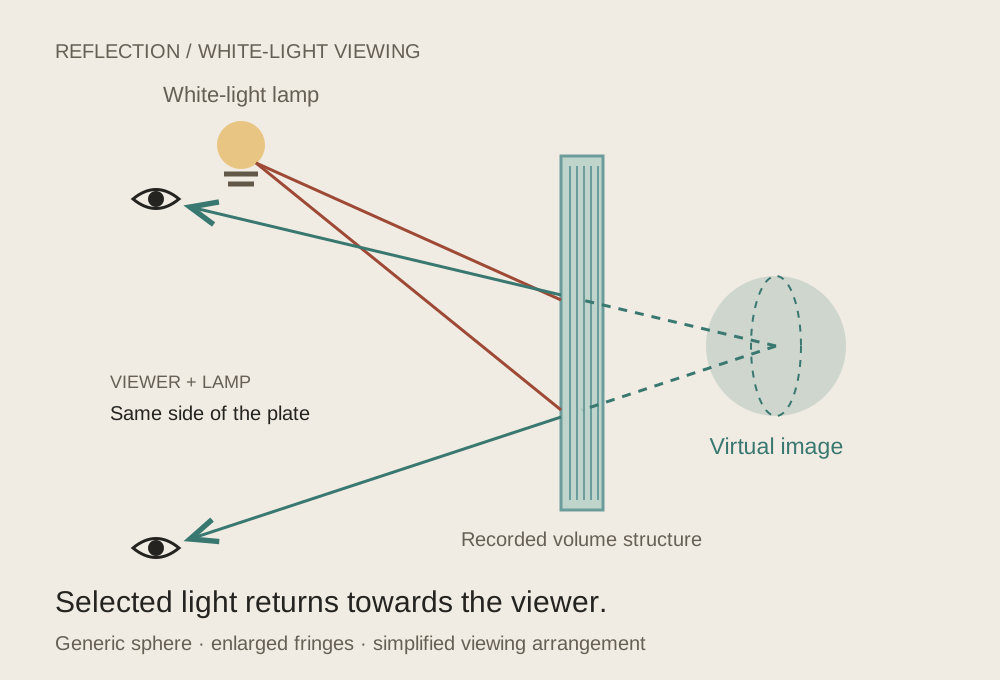
Original reflection-hologram diagram showing a lamp and viewer on the same side of a plate, with selected light returning to the viewer and dashed extensions locating a virtual image behind the plate.
Original explanatory diagram; follow the source link to see the real example. Image: Through Mirror · original explanatory diagram · Source · CC0 1.0. Original explanatory diagram (2026); viewing previews may be resized.
See Schreiber’s reflection holograms ↗
02 / 2017 · reflection hologram

Reflection holography — Cassadaga (Spirit Pond)

An image in a glass plate, revealed by a light bulb

A lamp illuminates a flat plate and an image appears to occupy depth. The light returns towards the viewer from a recorded structure inside the holographic material.

Matthew Schreiber identifies Cassadaga (Spirit Pond), 2017, as a 12 × 16 inch reflection hologram. His portfolio places it among decades of holographic artworks, many made on silver-halide-coated glass and displayed using a light bulb. These recorded optical images can work without a video player or projector.

For a reflection hologram, the object and reference waves meet in the recording material from opposite sides. The resulting fine layers form a volume structure that selectively diffracts light back towards the illuminated side. A suitable white-light source can therefore reconstruct the image while the viewer and lamp are on the same side of the plate. Denisyuk’s single-beam arrangement is one way to make this type of hologram.

EXPLORE THE HOLOGRAM

Find Cassadaga (Spirit Pond) in Schreiber’s portfolio, alongside his Bowie reflection holograms and Heart Lake Denisyuk hologram. Compare the thin physical support with the pictured depth. In a physical display, move within the viewing zone while the lamp stays fixed to explore the changing perspective.

Reflection holography uses diffraction from a recorded interference structure. Pepper’s Ghost instead reflects an already formed scene in ordinary glass or foil. The diagram is a general reflection-hologram viewing arrangement, not a recreation of Schreiber’s artwork.

Matthew Schreiber · Cassadaga (Spirit Pond)

Open the full entry & images →
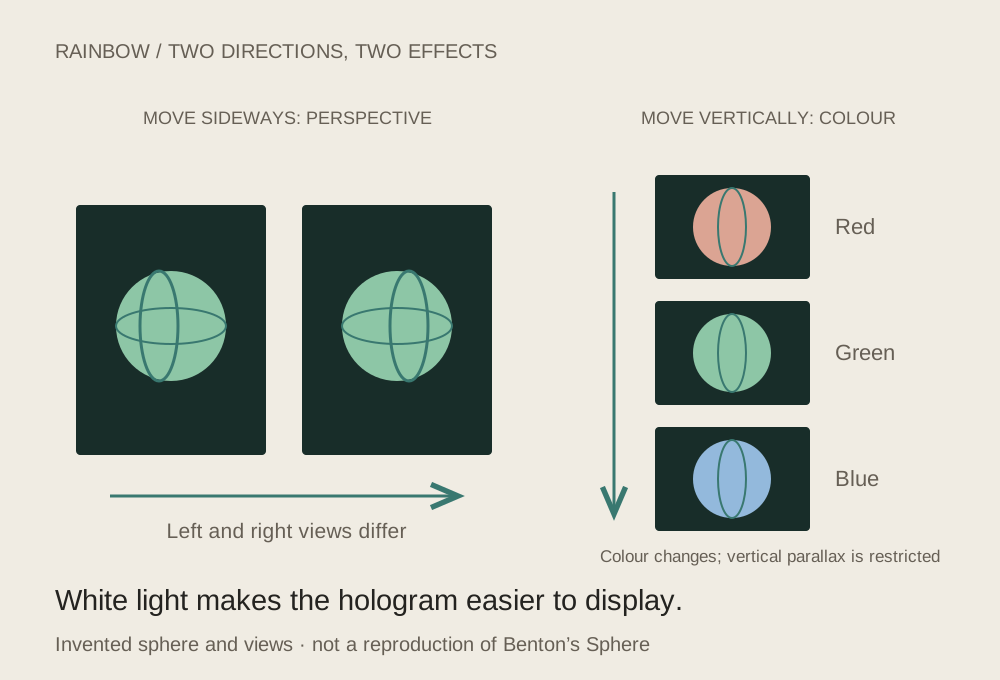
Original comparison of rainbow-hologram viewing: two side-by-side views of a generic sphere show horizontal parallax, while vertically stacked views change from red to green to blue without adding a new vertical perspective.
Original explanatory diagram; follow the source link to see the real example. Image: Through Mirror · original explanatory diagram · Source · CC0 1.0. Original explanatory diagram (2026); viewing previews may be resized.
Find Sphere in the 1975 exhibition catalogue (PDF) ↗
03 / 1968 · white-light transmission holography

Rainbow holography — Benton’s Sphere

Depth from side to side; changing colour from top to bottom

A hologram becomes visible in ordinary white light. Move sideways to explore depth; move vertically and its colour changes through the spectrum.

The Museum of Holography’s Holography ’75 catalogue lists Stephen Benton’s Sphere, November 1968, as a white-light transmission hologram made at Polaroid. Benton’s rainbow method helped make holography accessible outside laser-lit displays. MIT also describes its later use in credit-card holograms.

A rainbow hologram is transferred from a master using a narrow horizontal slit. The slit preserves side-to-side perspective while restricting vertical parallax, reducing the blur that white-light reconstruction would otherwise produce. Different wavelengths emerge at different vertical angles. Moving your eyes up or down selects a different spectral colour; moving sideways still reveals different views of the object.

EXPLORE THE HOLOGRAM

Find Sphere in the Museum of Holography’s 1975 exhibition catalogue, then compare the two directions in the diagram. In a rainbow hologram, sideways movement changes perspective; vertical movement mainly changes colour. Look for a similar effect in a holographic foil on a card or package.

‘Rainbow’ describes the viewing method, not the object’s original colours. Many security foils combine several diffractive effects, so a shiny rainbow surface alone does not prove that it contains a three-dimensional holographic image. The diagram is an invented sphere, not a reproduction of Benton’s Sphere.

Stephen A. Benton · Sphere, made at Polaroid

Open the full entry & images →

Frequently asked questions

How does optical holography record depth?

An object wave interferes with a coherent reference wave in a recording material. The resulting pattern encodes amplitude and relative phase. Suitable illumination is diffracted by the developed hologram to reconstruct a wavefront, allowing different perspectives within its viewing zone.

Do all holograms need a laser for viewing?

No. Gary Fisher’s Optical Interactions is a laser-viewable transmission hologram. Reflection holograms, such as Matthew Schreiber’s Cassadaga (Spirit Pond), and rainbow holograms can be displayed with suitable white light. The required illumination depends on how the hologram was made.