A room sticks out of the wall yet seems to lead inside it. A table widens into the distance. A collage lets you walk around a desk with your eyes. Artists can turn the familiar rules of perspective around and make us reconsider where we stand.
4 works by three artists: Patrick Hughes, Andrei Rublev and David Hockney.
Patrick Hughes: a surface that seems to turn
The nearest parts of a painted relief can depict the farthest parts of its scene. Compare the first experiment with a later, more complex work.
A painted relief that turns a projecting shape into a room
A painted room appears to recede into the wall, although its apparent back wall projects towards the viewer.
Hughes dates his first reverspective to 1964. Sticking-out Room introduced a contradiction between a solid support and the room painted on it. He later returned to reverspectives and developed larger, more intricate scenes.
A truncated pyramid projects outwards, but its painted perspective suggests an inward room. Near and far exchange roles. When the depth inversion holds, moving past the relief can make the painted scene seem to turn.
LOOK FOR THIS
Compare the left-hand photograph in Figure 1 with the construction views in Figure 2 of the linked paper. Find the apparent back wall, then ask which part is physically closest. Use the artist’s films to see how a moving viewpoint changes a reverspective.
A single flat photograph cannot reproduce the complete effect. Close viewing with both eyes can reveal the actual projecting surface. The artist invented this relief technique, rather than the older tradition of inverse perspective in icons.
Three projecting forms become an apparently receding scene
Several projecting surfaces join into a convincing painted space whose depth can reverse as the viewer moves.
Real Reflections appears in the 2019 paper co-authored by Hughes and vision scientist Thomas Papathomas. It shows how far Hughes developed the simple construction of his early room.
The support combines three elongated truncated pyramids. Painted depth cues oppose that physical relief, encouraging an inverted reading. Changes of viewpoint then produce an apparent movement within the scene.
LOOK FOR THIS
Look at the right-hand image in Figure 1 of the linked paper. Compare its repeated projecting forms with the single form in Sticking-out Room. Then watch the artist’s filmed works for the apparent turning and sliding produced by a moving camera.
The title refers to the artwork. The illusion depends on painted relief and viewpoint; it does not require a moving mechanism. The films linked here show other reverspectives, rather than a recording specifically identified as Real Reflections.
Inverse perspective belongs to an older pictorial tradition. Furniture and architecture can open out while different parts of an icon follow their own spatial arrangements.
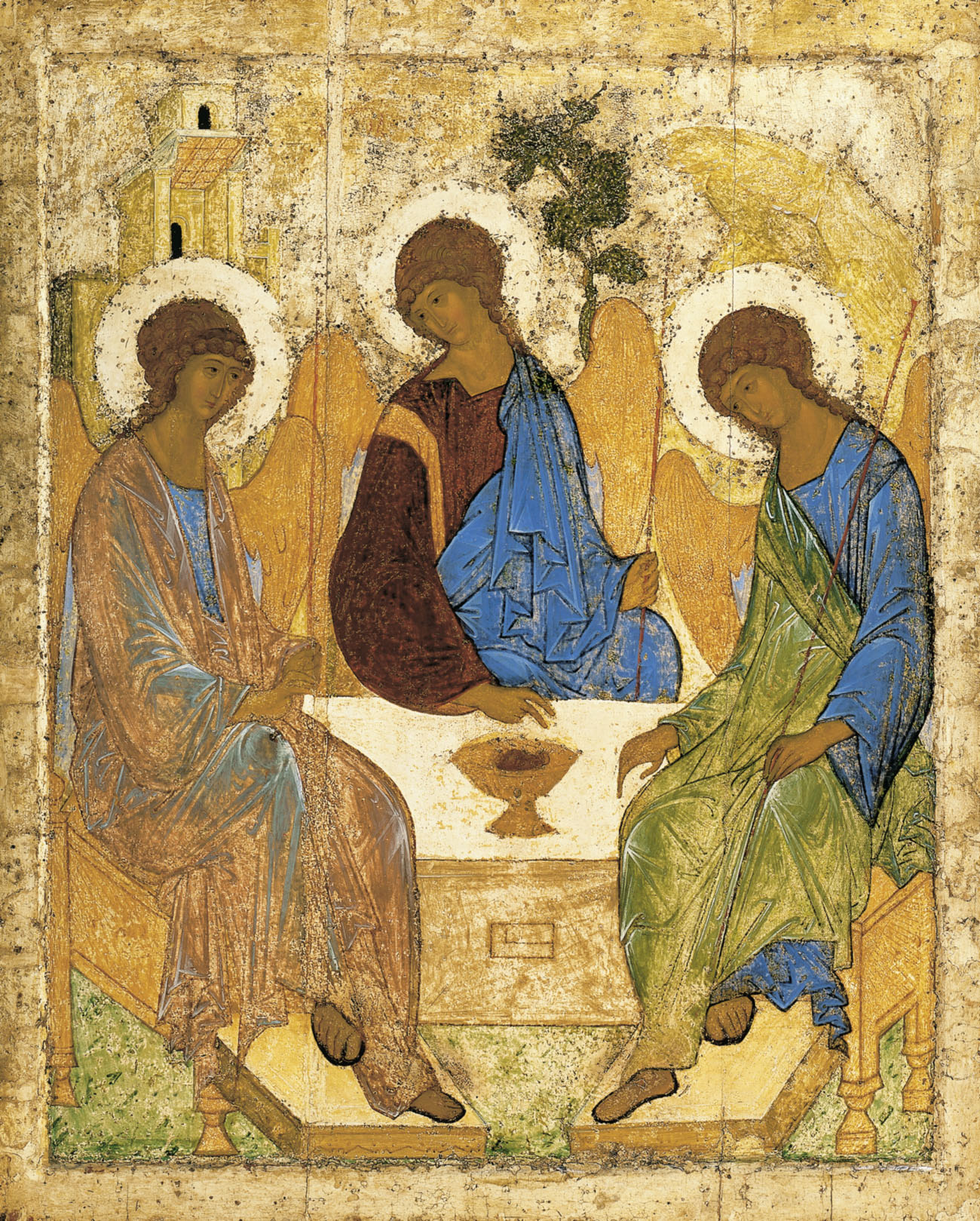
Andrei Rublev · Early 15th century · often dated 1411 or 1425–1427. Image: Andrei Rublev · faithful reproduction; photographer not identified in the source record · Source · Public domain (PD-Art). Unchanged public-domain reproduction from Wikimedia Commons; viewing previews may be resized.
03 / Early 15th century · often dated 1411 or 1425–1427
The Trinity
An icon made for the Trinity–St Sergius Monastery
Three angels gather around a table in a space whose furniture opens towards the viewer instead of following a single distant vanishing point.
Rublev painted this icon for the Trinity–St Sergius Monastery in the early fifteenth century. The Tretyakov Gallery’s historical discussion records competing dates of 1411 and 1425–1427. The angels’ arrangement and the surrounding objects form a religious composition rather than a view from one fixed camera position.
Inverse perspective can represent receding parallel edges as diverging and show more than one face of an object. Rublev’s furniture uses local spatial arrangements within the overall composition. The space need not obey one consistent geometric projection to remain readable.
LOOK FOR THIS
Follow the oblique edges of the footstools beneath the two outer angels. Compare their outward spread with a conventional perspective drawing, where receding parallel edges narrow towards a distant vanishing point. Look at the table and seats as separate local constructions.
The exact year is disputed; 1411 and 1425–1427 are commonly proposed dates. This flat icon does not create Hughes’s physical depth inversion or the same moving-viewer illusion. The reproduction records the icon’s weathered appearance.
A photographic ‘joiner’ assembled from changing viewpoints
A desk opens across a collage of photographs made from different positions. Its surfaces belong to a walk around the subject rather than a single camera view.
The 1984 collage is reproduced in the gallery guide for Hockney’s Bigger & Closer exhibition. In a Smithsonian oral-history interview that September, Hockney explains his reversed desk perspective in terms of walking past it, changing distance and playing with scale.
Individual photographs preserve their own camera views. Hockney arranges them into a larger picture with changing viewpoints and scale, allowing the desk to expand away from the viewer. The collage records attention and movement across a subject rather than one optical instant.
LOOK FOR THIS
Open the source reproduction and trace the two sides of the desk. Notice how the tabletop spreads and how you can see its top and front together. Follow the joins between photographs and imagine the changes of position needed to make them.
This is a flat photographic collage. Its viewpoint changes are built into the picture, so moving in front of a screen does not recreate the physical effect of a Hughes relief. The original reproduction remains linked to its source; copyright is David Hockney’s.
In inverse or reverse perspective, receding parallel edges can spread apart instead of converging towards a distant vanishing point. Artists may also combine several local viewpoints within one picture.
How does Patrick Hughes’s reverspective work?
Hughes paints a receding scene onto a relief that projects towards the viewer. When the painted depth overrides the physical shape, the scene can appear to turn or slide as the viewer moves past it.
Which artists use reverse perspective?
This guide compares Patrick Hughes’s Sticking-out Room and Real Reflections, Andrei Rublev’s The Trinity, and David Hockney’s The Desk, July 1st 1984. Their works use painted relief, icon painting and photographic collage respectively.
Can a photograph reproduce a reverspective illusion?
A photograph records one view of a relief. Video can demonstrate changes produced by a moving camera, while the physical artwork adds binocular depth cues and the viewer’s own movement. A flat icon or collage constructs space differently.
Is reverse perspective the same as turning a picture upside down?
Reverse perspective changes how depth or viewpoint is represented. A reversible painting reveals another subject after rotation. The two techniques have different effects.