Instructions
Look at the image. What do you see?
Effect
You should have the visual experience of a man seeming to climb down into a 3D swimming pool. However, although the man is real, the swimming pool is just a cleverly constructed 2D drawing on the pavement.
Illusion credit
Julian Beever (1959 –), a British sidewalk chalk artist
Swimming-Pool in the High Street art illusion was created by Julian Beever (1959 –), a British sidewalk chalk artist, who first published the illusion in his book Pavement Chalk Artist: The Three-Dimensional Drawings of Julian Beever in July 2012 (see Beever, 2012).
Swimming-Pool in the High Street is one among a large number of anamorphic illusions in which a cleverly constructed two-dimensional painting looks like a three-dimensional object either when seen from the right angle (in perspective forms of anamorphism) or when viewed with a mirror in the right location (in mirror forms of anamorphism).
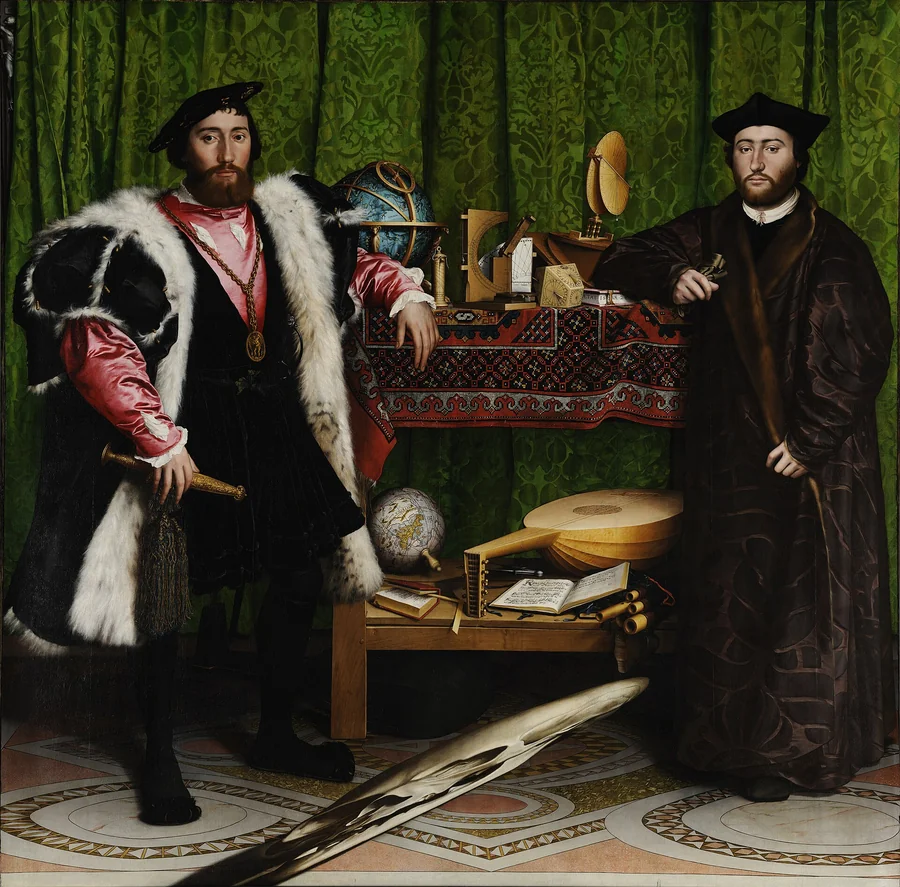
A famous early example is found in Hans Holbein the Younger’s The Ambassadors. When viewed from the bottom right, the otherwise distorted image in the bottom of the picture reveals itself to be a skull.
Image courtesy of the National Gallery under a Creative Commons licence
When viewed from the right perspective, the distorted skull in the middle should look like this:
This video from “brusspup” shows how powerful anamorphic images can be:
Video demonstration in the player above.
You can download and print out some of the images used in the video to re-create the effect for yourself. (See below.)
Perspective forms of anamorphic images are usually forms of ambiguous figure because while one can be fooled and experience the anamorphic images as 3-D objects, one can also often see them as distorted 2-D images. Unlike ordinary ambiguous, such as the duck-rabbit that you can see on the Illusions index, perspective anamorphic images require that you see the image from a particular angle.
The mirror form of anamorphic images has been explored extensively by artist István Orosz. Two examples of his are below. The second example is his most famous work, called Mysterious Island. A picture of author Jules Verne emerges when a cylindrical mirror is placed in the right location.
Anamorphic images beautifully illustrate the fact that the light that falls on our retina, and the subsequent visual experience that you have, could be produced by a large number of different arrangements of objects and properties in the world in front of you. Both a 3-D object and a 2-D image can cause the same light to fall on your retina, which can then cause the same experience. When we look at ambiguous figures, our experience can flip and we can have an experience of two seemingly different things. In the case of anamorphic images, we can experience at different times an apparent 3-D object (which the anamorphic images fool us into having) and what is really there (the 2-D picture).
Anamorphic images also raise the philosophical question of whether we ever really directly see the way that the world is, or if we only really see an image or representation of the world that is generated in our mind (a sense-datum). See Crane & French (2016) for discussion of sense-data and related issues.
Below are a couple of anamorphic images that you might want to print out to recreate the effect in the video above.
References
Beever, J. (2012). Julian Beever. Available online: http://www.julianbeever.net/
Beever, J. (2012). Pavement Chalk Artist: The Three-Dimensional Drawings of Julian Beever. Ontario: Firefly Books
Crane, T., and French, C., 2016. The Problem of Perception. In: Zalta, E. N., ed. The Stanford Encyclopedia of Philosophy. Metaphysics Research Lab, CSLI, Stanford University.
Article links
Additional images & credits
Images and audio are stored on this website. Source media credits and license labels are reproduced as supplied; an author credit alone does not grant a reuse license.
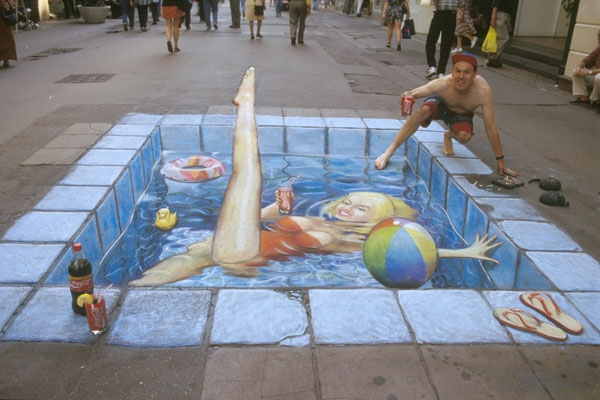
A pavement painting of a swimming pool with a person sitting at its edge, seen from the illusion’s convincing viewpoint.
One could experience this image as depicting either a 2D or 3D object.
Source license / credit label: Julian Beever.
Source credit: http://justsomething.co/3d-pavement-drawings/.
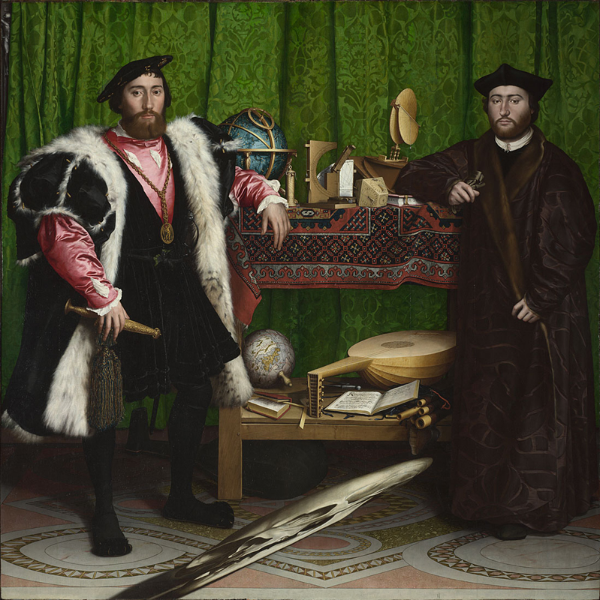
The Ambassadors by Holbein, with two men, scientific instruments and a stretched skull on the floor.
Source license / credit label: Not specified for this media item.
Source credit: Julian Beever (1959 –), a British sidewalk chalk artist.
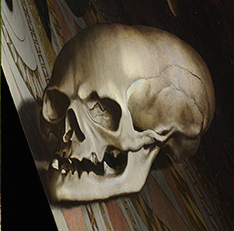
A close view of the skull in The Ambassadors from an angle that makes its distorted shape recognisable.
Source license / credit label: Not specified for this media item.
Source credit: Julian Beever (1959 –), a British sidewalk chalk artist.
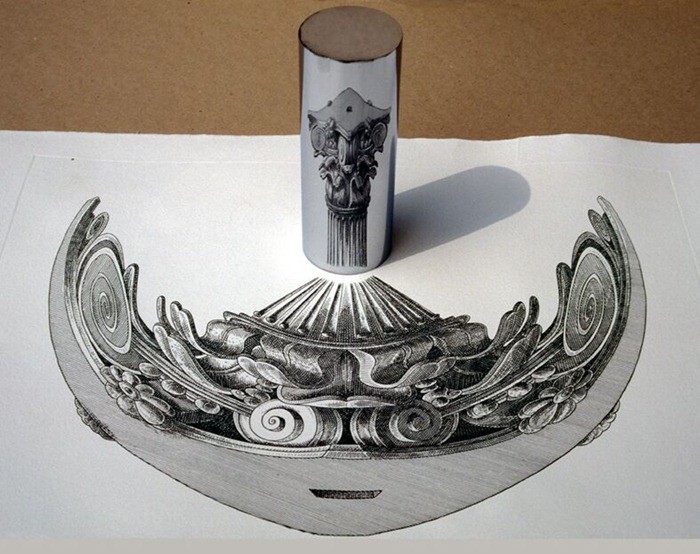
A reflective cylinder stands on a distorted decorative drawing and reconstructs the image in its curved reflection.
Source license / credit label: Not specified for this media item.
Source credit: Julian Beever (1959 –), a British sidewalk chalk artist.
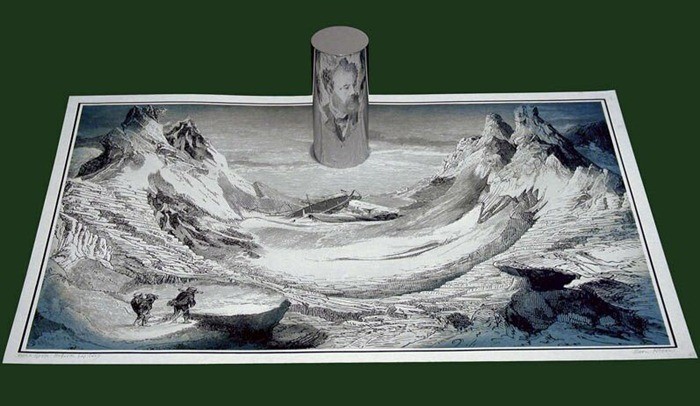
A reflective cylinder on a distorted mountain landscape reconstructs part of the scene on its curved surface.
Source license / credit label: Not specified for this media item.
Source credit: Julian Beever (1959 –), a British sidewalk chalk artist.
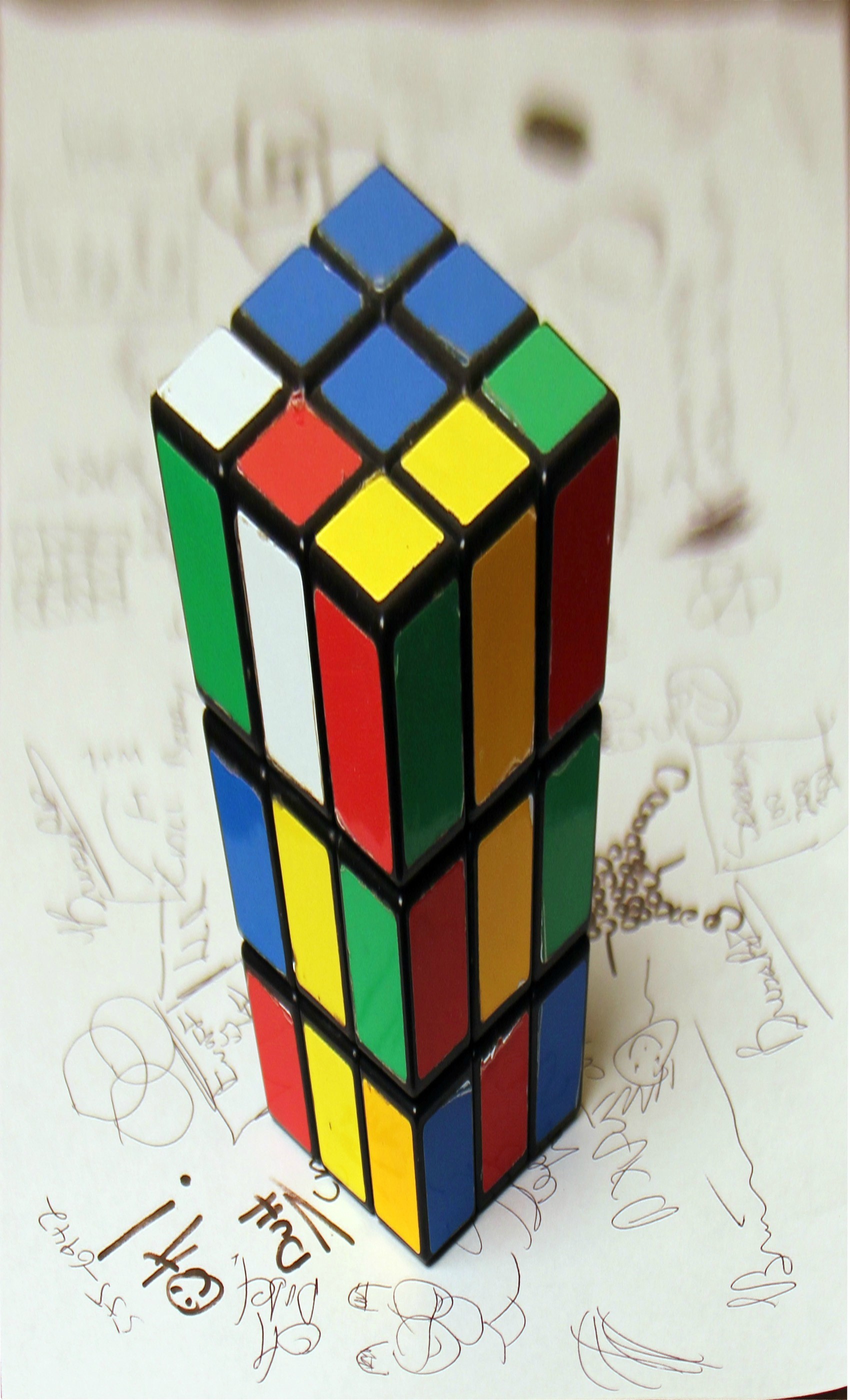
A multicoloured puzzle cube viewed so that its perspective makes the upper face appear to project upwards.
Source license / credit label: Not specified for this media item.
Source credit: Julian Beever (1959 –), a British sidewalk chalk artist.
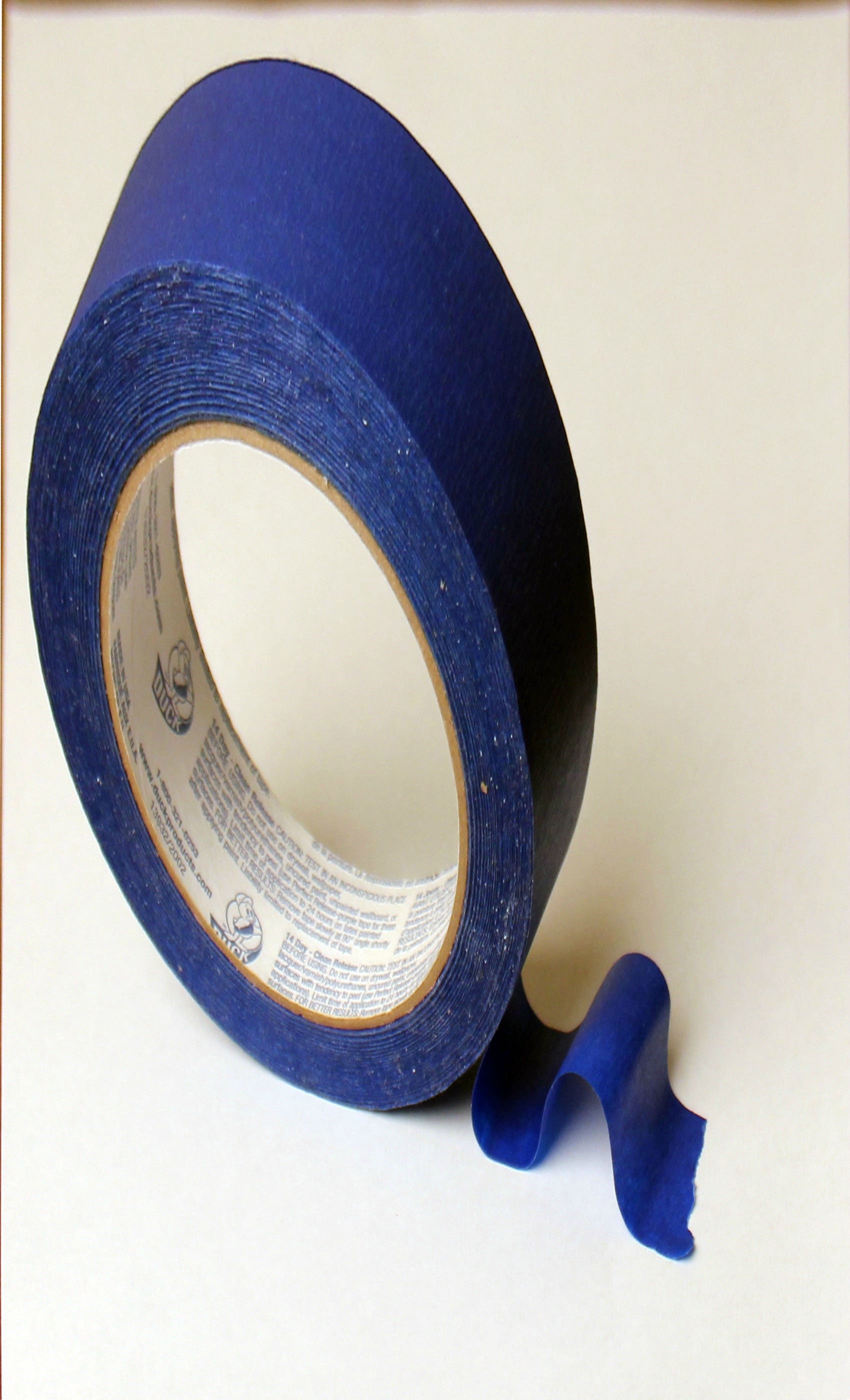
A blue roll of tape casts a shadow on a white surface.
Source license / credit label: Not specified for this media item.
Source credit: Julian Beever (1959 –), a British sidewalk chalk artist.