The Dutch printmaker who made stairs climb forever, hands draw themselves, and separate worlds share the same room. His woodcuts and lithographs turn perspective, reflection and repeating patterns into visual stories.
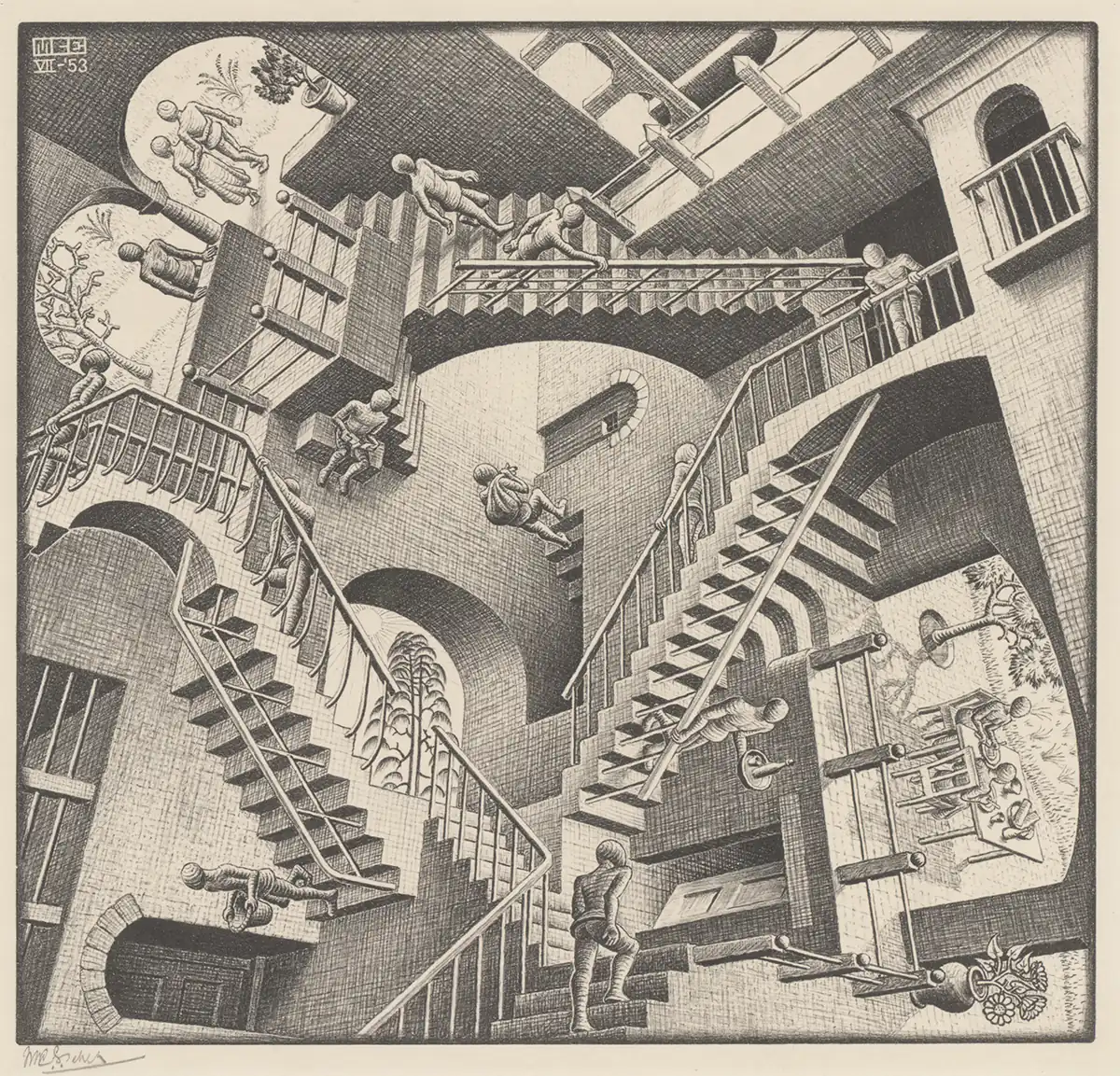
Three directions of gravity share one building. Each person's world makes sense on its own; together, the stairs connect incompatible floors and walls. Escher made both lithograph and woodcut versions in his exploration of multiple viewpoints.
Follow one person along a staircase, then follow the person beside them.
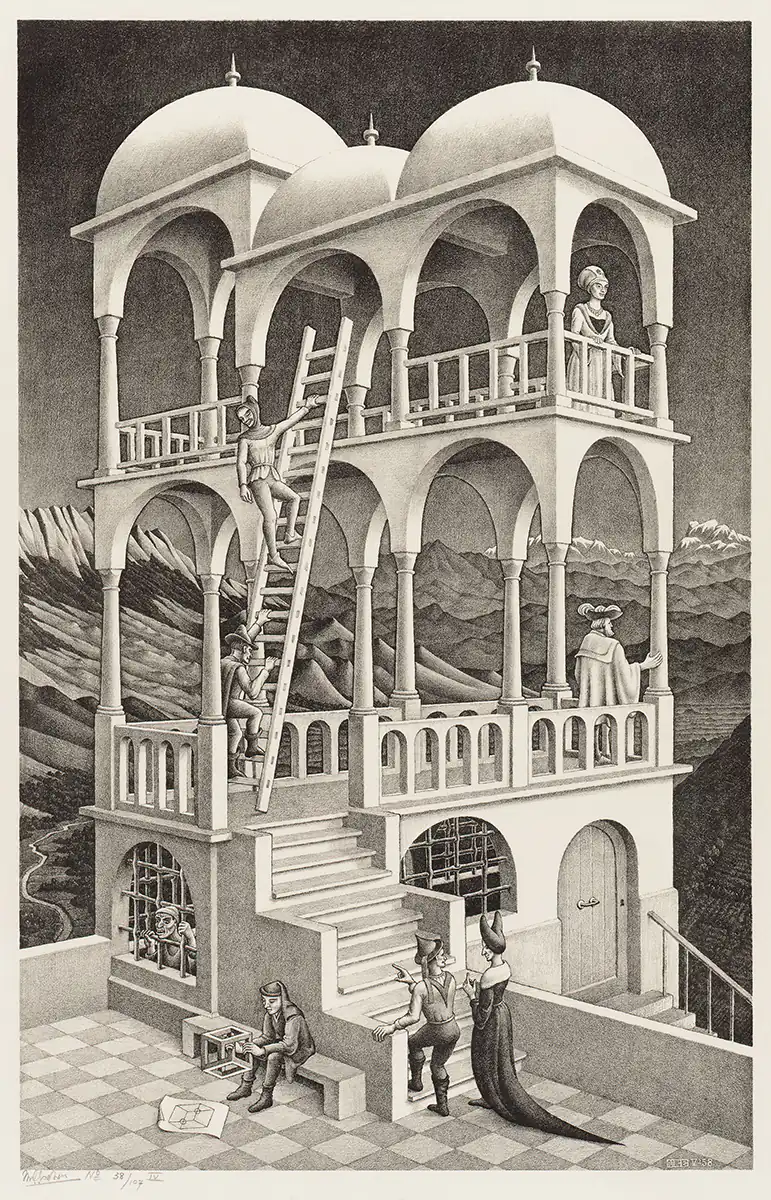
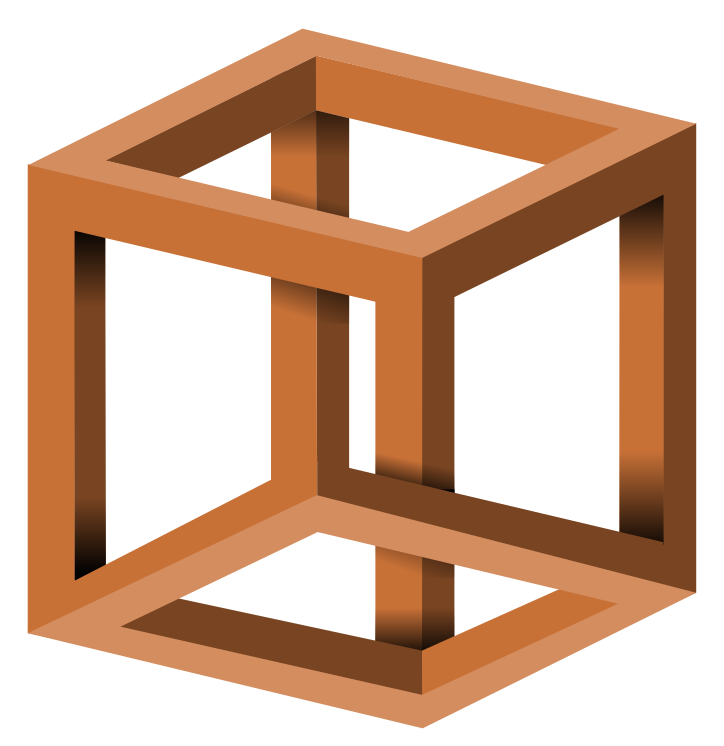
A pavilion's upper and lower storeys look plausible separately, but its columns connect them impossibly. The seated figure holds an impossible cube, a small clue to the larger architectural trick.
Trace each column from its foot to its top, then inspect the ladder.
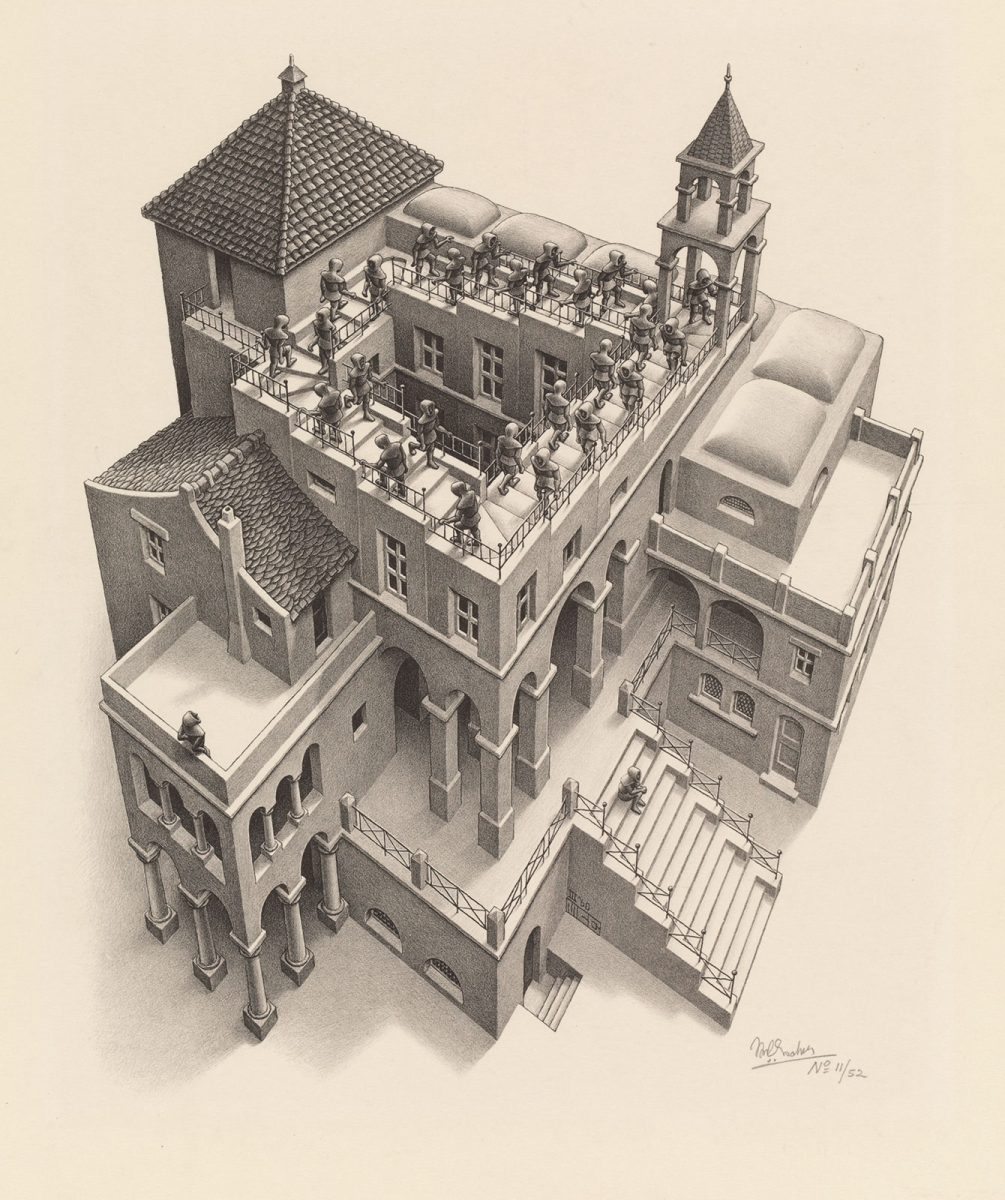
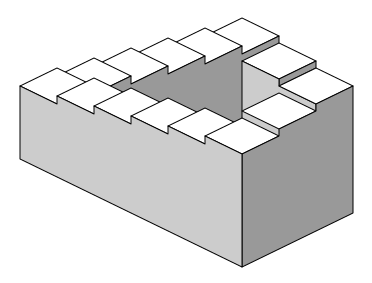
Two processions circle a rooftop stairway without ever gaining or losing height. The Penroses' 1958 paper on impossible objects sparked the print; Escher sent them an impression with his thanks in April 1960.
Walk around the staircase with your eyes. Where should the height difference go?
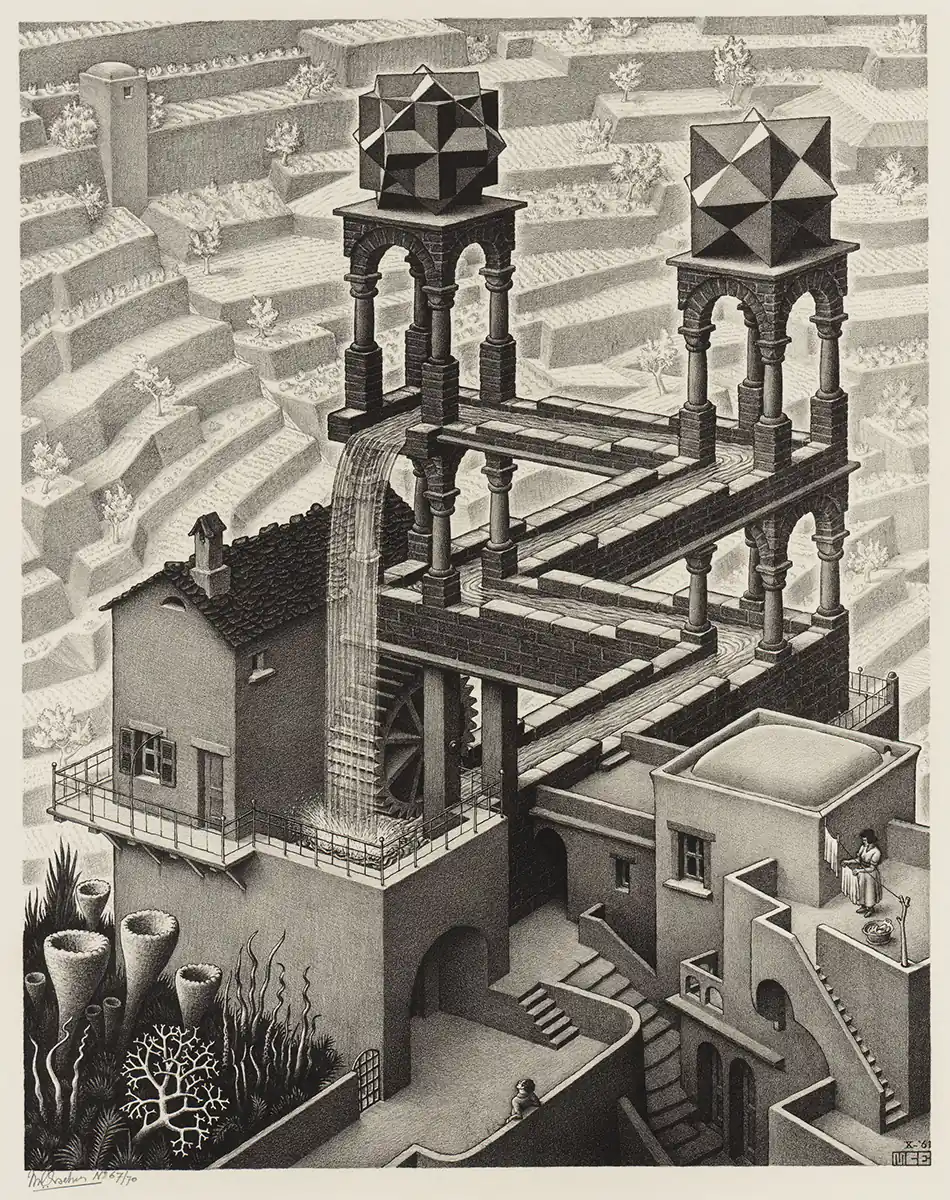
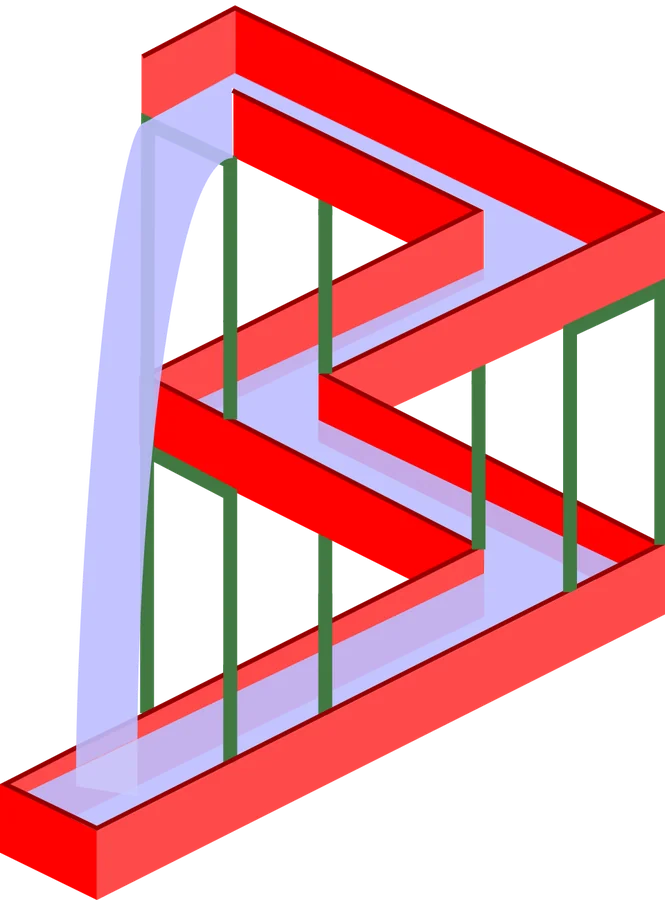
An aqueduct seems to carry water downhill, yet delivers it above the wheel where it began. Escher builds a perpetual-motion fantasy by joining plausible local views into an impossible circuit.
Follow the water instead of the towers. Does its apparent slope agree with its destination?
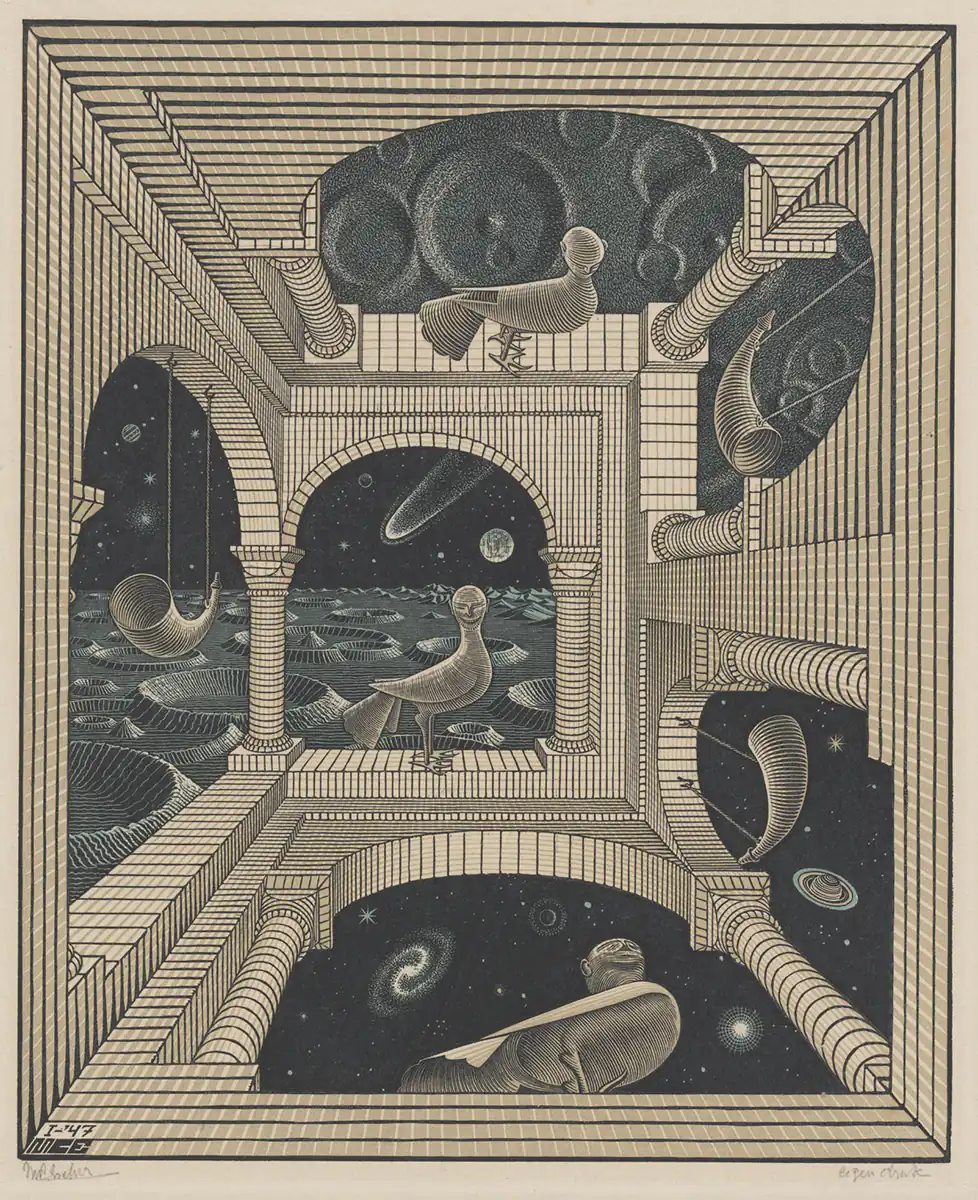
A cube-shaped room opens onto a lunar landscape through three incompatible perspectives. Its repeated bird-headed figure is based on a Persian simurgh statuette Escher received as a wedding gift in 1924.
Decide which surface is the floor. Now look through another opening.
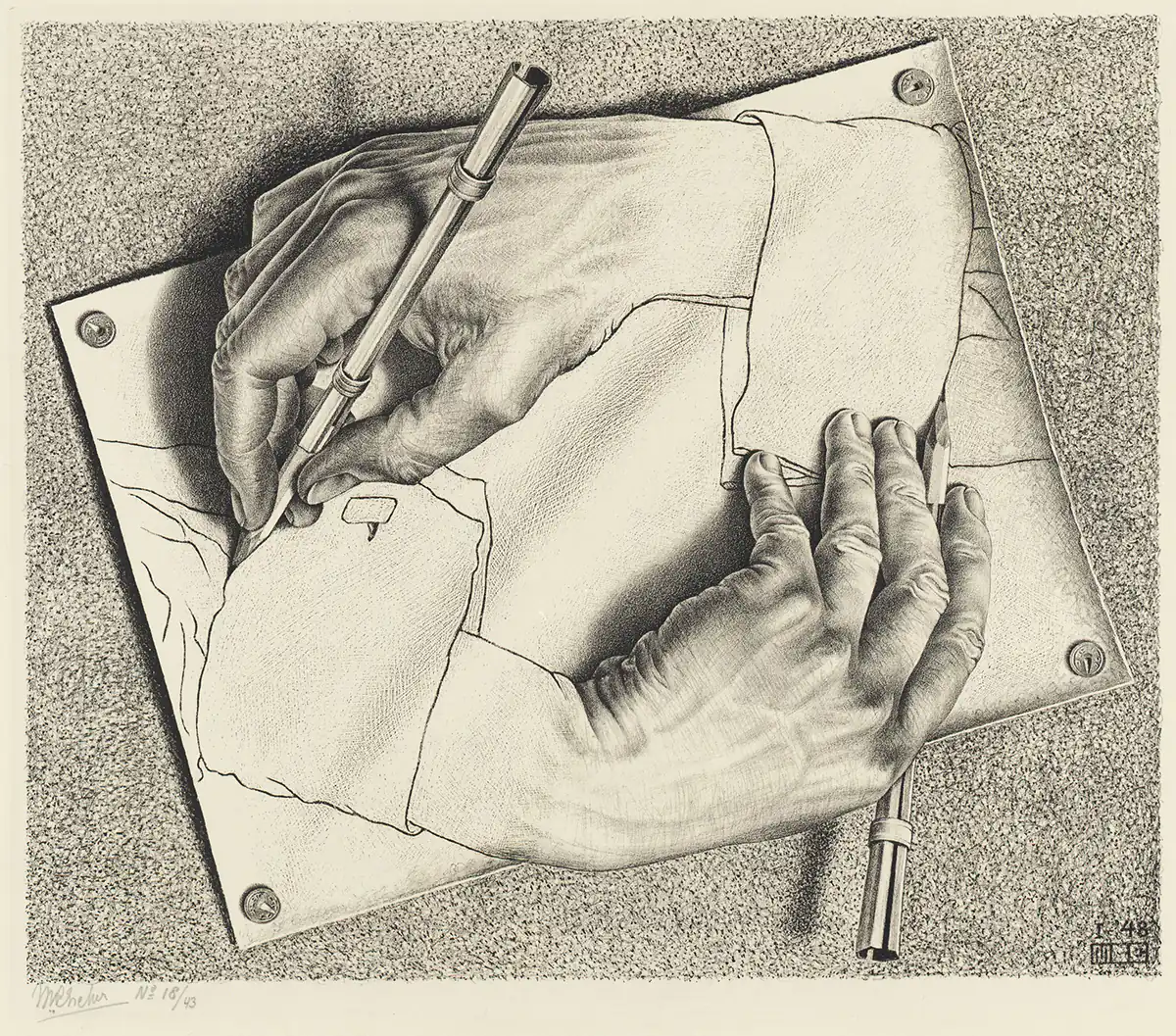
Two convincing hands emerge from a flat sheet and draw each other's sleeves. Escher used his own right hand as a model, turning a study of the hand into a loop with no first creator.
Notice where the flat sleeve becomes a solid wrist.
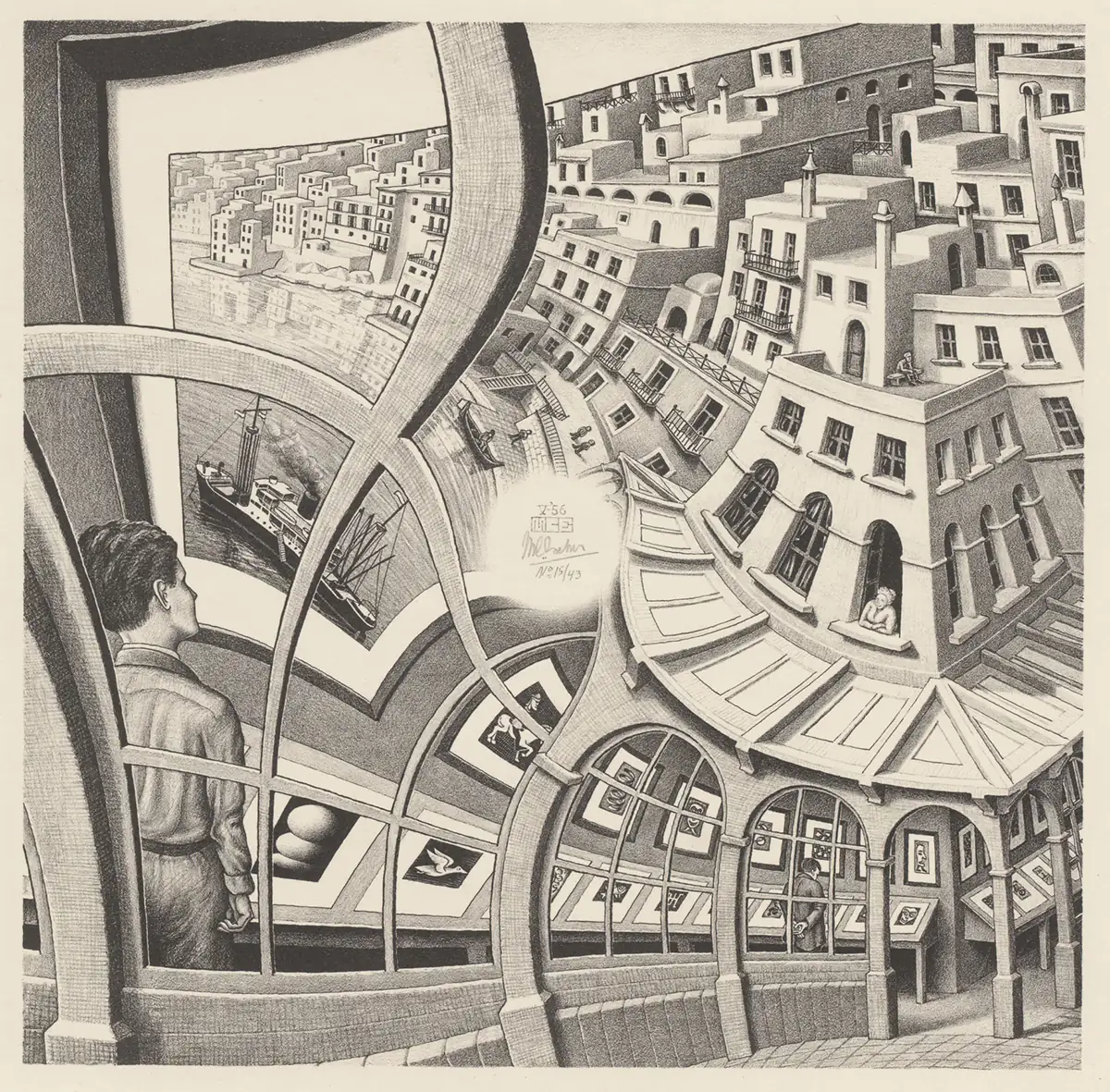
A visitor examines a print of Senglea, Malta, whose buildings expand to include the gallery and the visitor himself. Escher worked out the swirling transformation intuitively, leaving its centre blank; mathematicians later studied and completed that gap.
Start with the visitor, then follow the town around the picture.
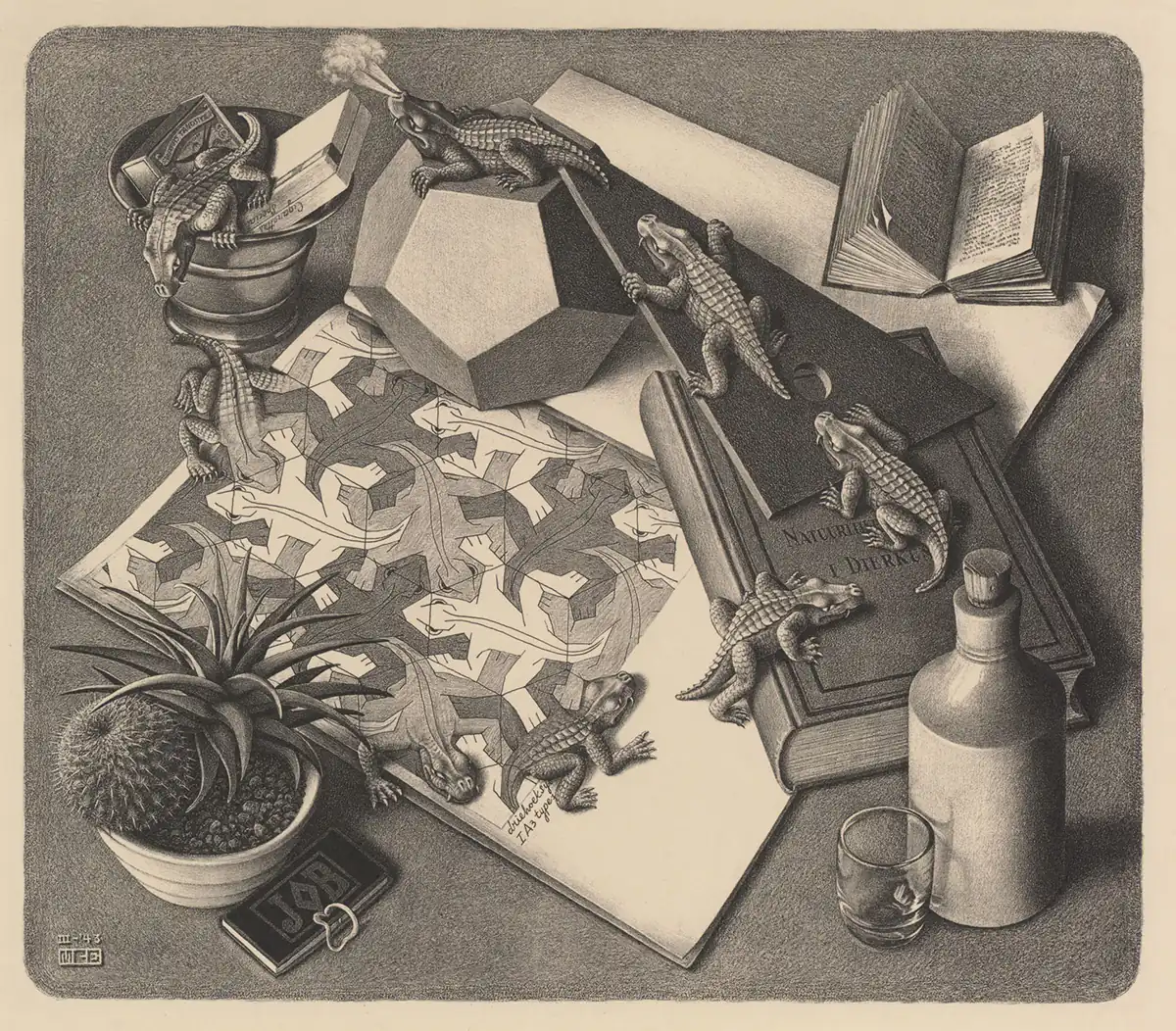
A lizard leaves a tessellated drawing, crawls over objects on the desk, then becomes part of the flat pattern again. Escher turns a repeating design into a story about crossing between two and three dimensions.
Find both places where the animal changes from pattern to creature.
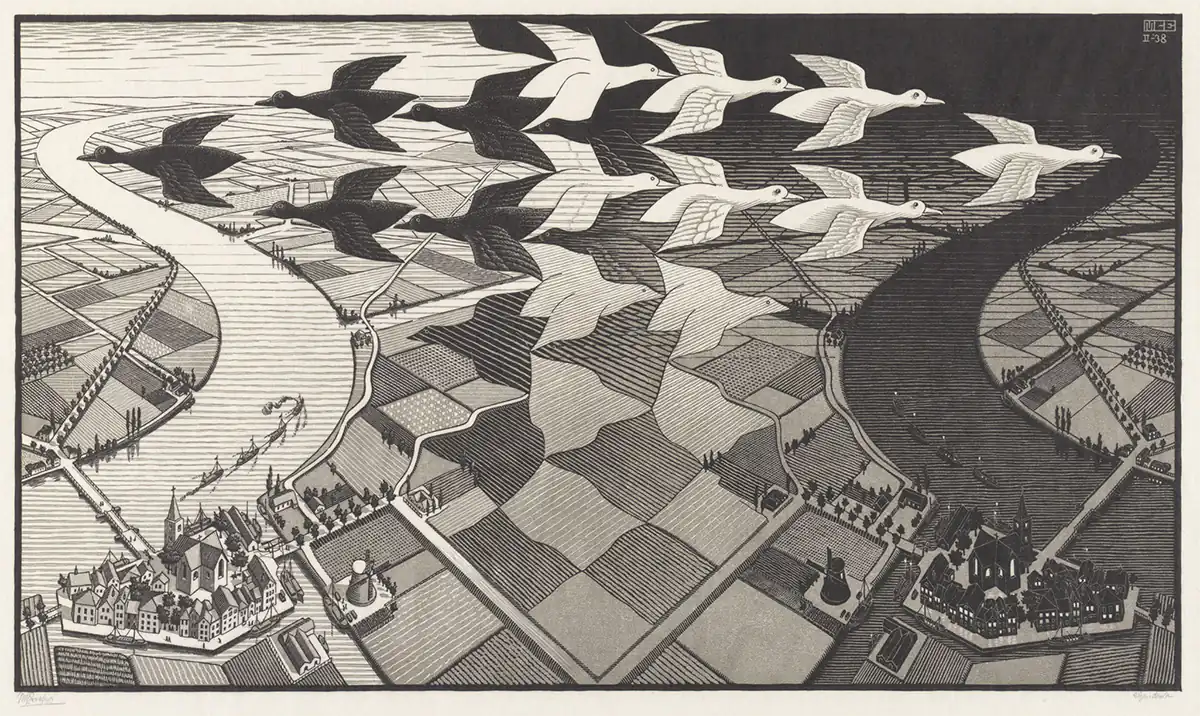
Fields become interlocking black and white birds flying through opposing landscapes of day and night. Tessellation provides the bridge from repeating flat shapes to a recognisable landscape.
Watch the fields at the centre turn into the bodies of birds.
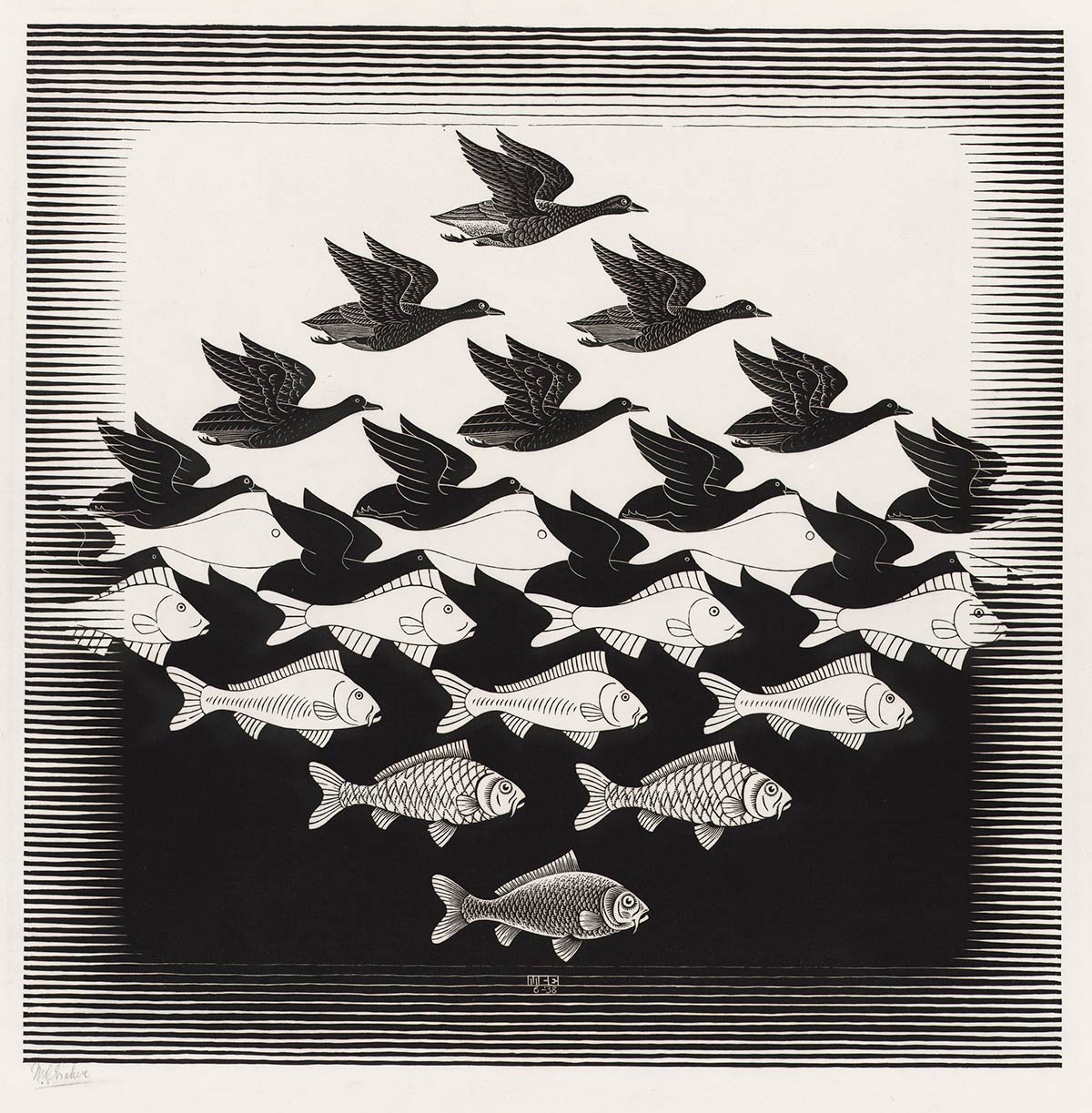
Birds and fish fit together in the centre. As the pattern opens up, the spaces between fish become sky and the spaces between birds become water. Escher makes figure and background exchange roles.
Look at the white shapes first, then the black ones.
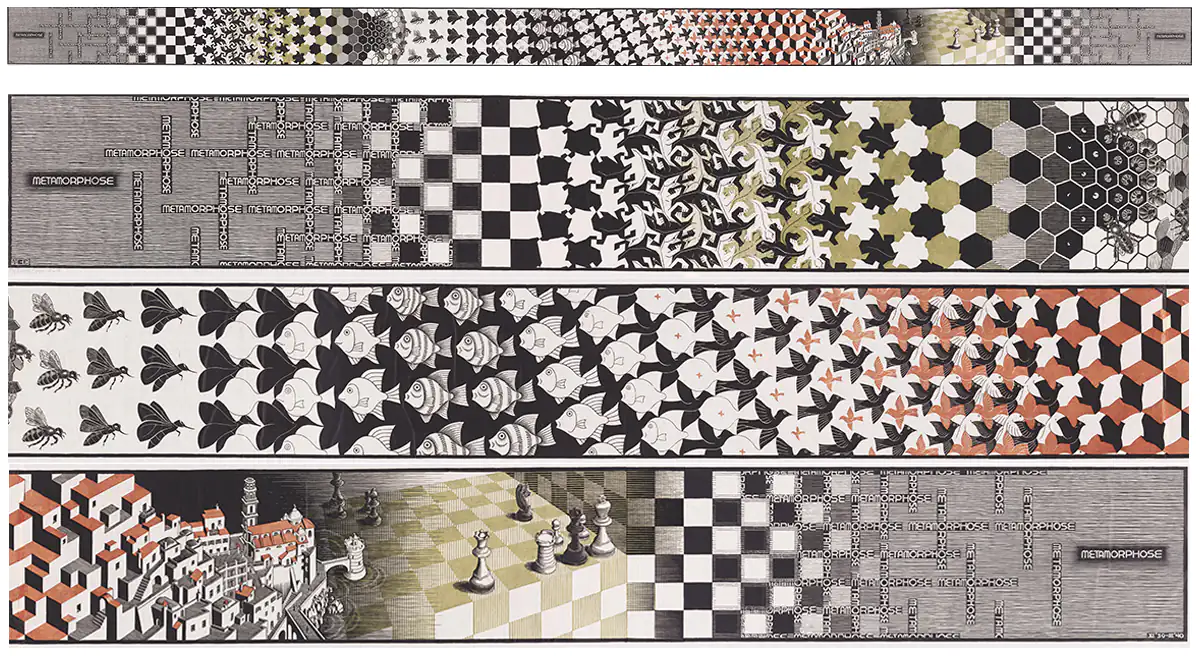
Letters, reptiles, insects, birds and buildings change into one another across a print almost four metres long. Atrani, a town Escher visited on Italy's Amalfi Coast, becomes part of a cycle that returns to its opening word.
Follow the strip all the way to the chessboard and back to the lettering.
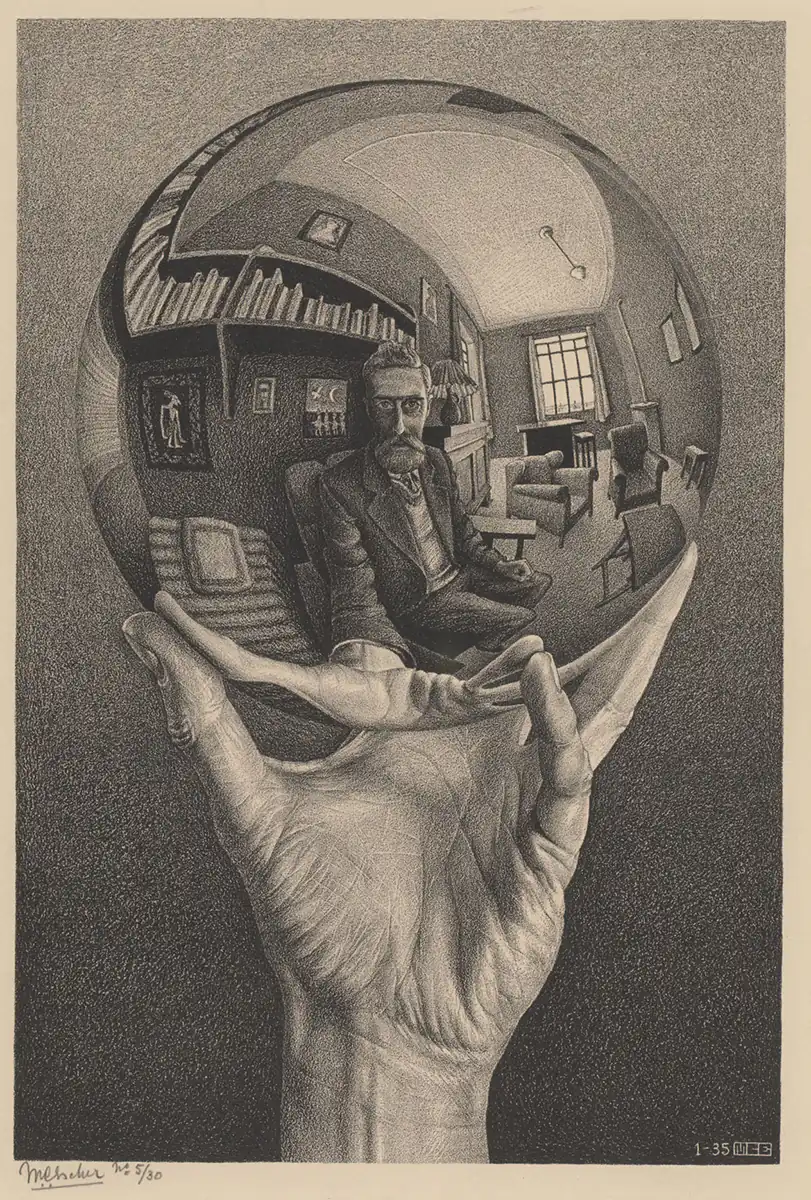
The mirrored ball reveals Escher and his studio on Via Alessandro Poerio in Rome. A convex reflection enlarges nearby objects and compresses the surrounding room, bringing the artist and his world into a single curved image.
Compare the hand outside the sphere with the room reflected inside it.
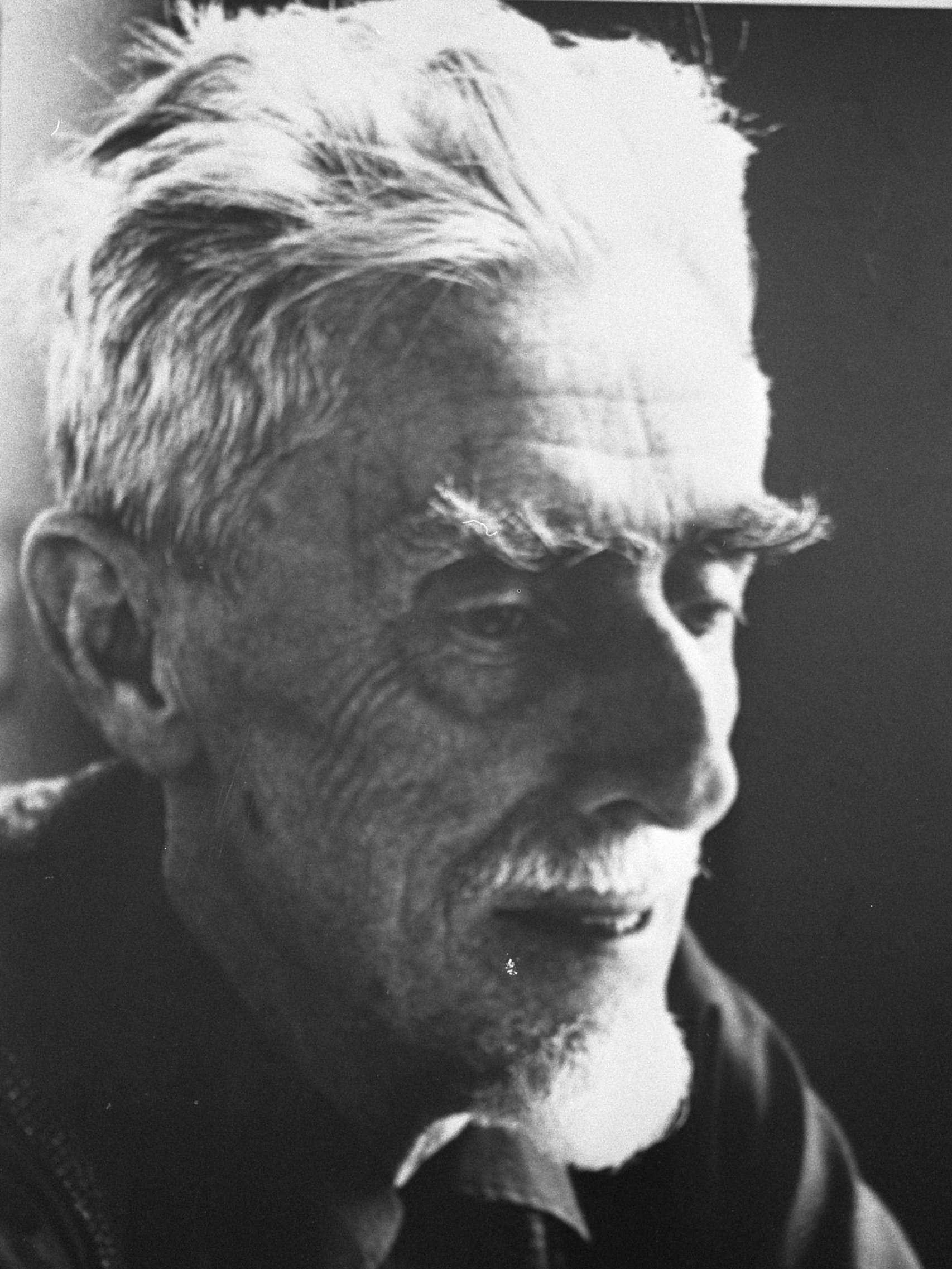
M. C. Escher was a Dutch printmaker whose work explored impossible spaces, reflection, repeating patterns and relationships between different worlds. His prints combine careful drawing with surprising geometric ideas.
Which Escher prints are in this guide?
The guide covers twelve famous prints, including Relativity, Belvedere, Ascending and Descending, Waterfall and Drawing Hands. Each entry shows a locally stored museum reproduction beside its explanation and links to the museum’s history.
Can I download the Escher images shown in this guide?
Yes. Download each museum reproduction from its entry, or get all twelve images in one ZIP with source credits. Copyright remains with The M. C. Escher Company; the modern diagrams and Escher’s portrait have their own credits and terms.